
A few years ago, I wrote about something I called "the accepted lie" in sales enablement. The lie is simple: that training leads to performance. That if you teach reps the right things, they'll do the right things. That knowledge transfer equals behaviour change.
The data has always said otherwise. People lose more than half of what they learn within 24 hours. Training completion has almost zero correlation with quota attainment. The average sales rep forgets 84% of their training content within 90 days.
Everyone in enablement knows this. And for years, we accepted it anyway. We ran the training, produced the completion reports, showed the board the green dashboard, and quietly moved on.
I thought we'd eventually move past it. I was wrong. We didn't move past the lie. We just gave it a costume change.
Same lie, shinier packaging
Open any sales enablement vendor's website right now. Count how many times you see "AI-powered" in the first scroll. I'll wait.
Here's what most of them are actually selling: the exact same content-delivery, training-first model they've been selling for a decade, but now with an AI chatbot sitting on top.
The flow hasn't changed:
- Create training content
- Assign it to reps
- Track completion
- Hope for the best
They've just added a step 2.5: "Let reps ask an AI chatbot questions about the training content."
That's not innovation. That's a search bar with a personality.

The costume looks different. The lie underneath is identical.
What the lie actually costs
Let me make this concrete, because I think people have become numb to the "training doesn't work" argument.
A mid-market sales organisation with 50 reps spends roughly 150,000 to 250,000 pounds per year on enablement technology, content creation, and facilitation. That covers the LMS, the content library, the trainers, and the occasional offsite.
Now, what does that investment produce? Completion certificates. Knowledge scores. Engagement metrics. None of which have ever been reliably linked to revenue performance in any peer-reviewed study I've seen (and I've looked, believe me).
So the organisation spends a quarter of a million pounds per year on an activity that makes everyone feel like something is happening, whilst the actual problem, that reps don't know how to run their specific deals with their specific buyers, goes completely unaddressed.
That's the cost of the accepted lie. Not just the budget. The opportunity cost. The deals that were lost because the rep got a training module instead of deal coaching. The pipeline that stalled because the manager was reviewing completion reports instead of reviewing calls.
The AI costume
Now layer AI on top and watch what happens.
The "AI-powered enablement" pitch goes something like this: "Our platform uses AI to personalise learning paths, recommend content based on skill gaps, and provide instant answers to rep questions."
Sounds brilliant. Let's break it down.
"Personalise learning paths" means the AI decides which training module you see next based on a quiz score. It's adaptive content sequencing. It's what e-learning platforms have done since 2010, except now there's a language model choosing the next module instead of a rules engine. The rep is still consuming content. The assumption that content consumption leads to performance hasn't changed.
"Recommend content based on skill gaps" means the AI looks at your assessment results and suggests more training. It's not identifying skill gaps from actual deal performance. It's identifying knowledge gaps from tests. Knowledge gaps and skill gaps are not the same thing. A rep can score 95% on a discovery framework quiz and still ask terrible questions on a live call. Ask any sales manager. They'll confirm this in about three seconds.
"Provide instant answers to rep questions" is a chatbot. It sits on top of the content library and lets reps ask questions instead of searching. That's useful! Genuinely useful, in the way that Google is useful. But it's not coaching. It's information retrieval. The rep still has to figure out how to apply the answer to their specific situation with their specific buyer. And that, the application in context, is the actual hard part that nobody is solving with a chatbot.
The training-first model is the problem
Here's what nobody in "AI-powered enablement" wants to admit: the model itself is broken, and no amount of AI can fix a broken model.
The training-first model assumes that the path to performance goes: learn the thing, then do the thing. Content first, application second.
In reality, adult learning works the other way around. You encounter the situation, you realise you don't know how to handle it, and then you seek out the knowledge or guidance you need.
That's why the reps who find AI coaching useful (and it's a small percentage, as we know) are the ones who use it in the context of a real deal. They're not completing modules. They're preparing for calls. They're working through objections they've actually received from actual buyers. They're learning because they need to, not because they've been assigned to.
The costume changed. The model didn't.
What would actually be different?
If we were serious about using AI to solve the performance problem in sales (rather than just relabelling the training problem), here's what it would look like:
Start with the deal, not the curriculum. The coaching should begin with "you have a call with Sarah at Acme on Thursday, and here's what you need to be ready for," not "here's module 4 of your onboarding track."
Measure behaviour change, not content completion. Did the rep ask better discovery questions after the coaching? Did they handle the pricing objection differently? You can measure this. Most platforms don't bother.
Coach in the flow of work, not in a separate platform. The moment you make a rep leave their workflow to go to "the learning platform," you've lost. Coaching has to meet the rep where they are: in the CRM, in the deal, in the moment.
Replace "did they know it?" with "did they do it?" The gap between knowing and doing is where all the revenue lives. Training addresses knowing. Coaching addresses doing. They are not the same activity, and calling them both "enablement" is part of the problem.
Kill the completion metric. I'm serious. Delete it. It has never predicted anything useful. Replace it with performance metrics tied to real deals. If that's harder to measure, good. Easy metrics that mean nothing are worse than hard metrics that mean everything.
The enablement industry doesn't have a technology problem
Let me say something that might be unpopular: the enablement industry doesn't need better technology. It needs a better model.
AI is genuinely transformative when applied to the right problem. Using AI to coach a rep through a specific deal scenario, to simulate a buyer conversation, to analyse what happened on a call and provide specific guidance for the next one. That's transformative. It's worth understanding what AI sales coaching actually is before you assume it's just training with a faster engine bolted on.
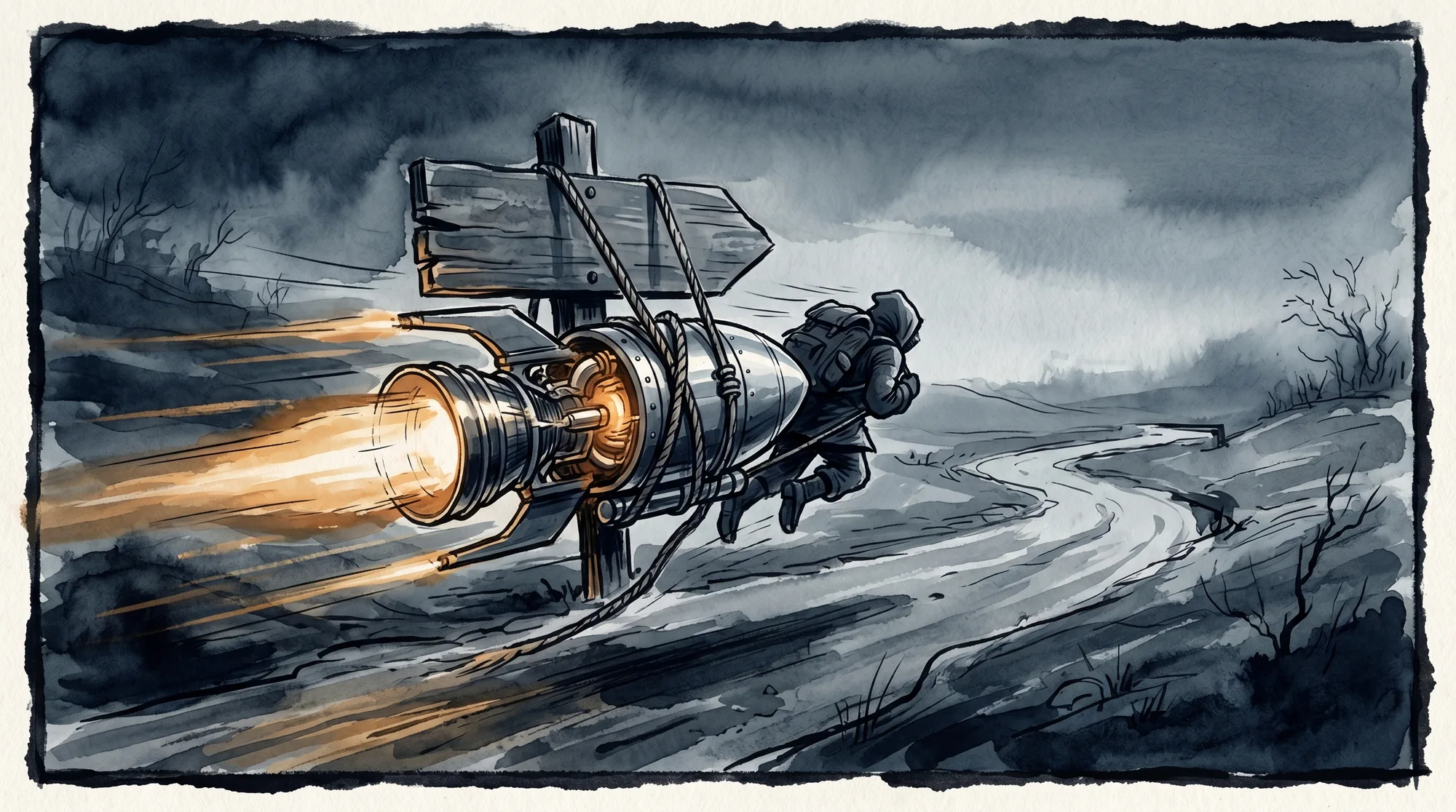
Using AI to deliver training content more efficiently is not transformative. It's automation of a process that shouldn't exist in its current form. You're using a supercomputer to send people to the wrong destination faster.
We need to stop lying to ourselves
The accepted lie survived for years because nobody had a better alternative. Training was all we had, so we pretended it worked and measured the things that made it look like it worked.
Now we have AI. And instead of using it to build something genuinely new, something that starts with the deal and ends with the outcome, we've bolted it onto the same training-first model and called it innovation.
The lie doesn't become true just because it's AI-powered. Training still doesn't reliably lead to performance. Content completion still doesn't predict quota attainment. And an AI chatbot sitting on top of a content library is still just a content library with better search.
The costume changed. The lie didn't.
And until we're honest about that, we'll keep spending billions on enablement technology that makes dashboards look great and changes nothing on the front line.
It's time to stop training reps and start coaching them.
Replicate Labs isn't AI-powered training with a new label. It's coaching built for real deals, real calls, and real outcomes. Free for reps and managers to get started. See the difference at replicatelabs.ai