
I'm pretty rubbish at poker. Always have been. But I've played enough to know this: if you sit down at the table without knowing the other players, without remembering the last three hands, without any sense of how the game has shifted since you arrived, you're not playing poker. You're gambling.
That's what your reps are doing right now. Not at a poker table. At their desks, at 11pm, copying a ChatGPT prompt from LinkedIn into a new chat window and calling it a sales coach.
And I'm not going to lie, part of me thinks it's brilliant.
Not because it works (it doesn't, not really), but because of what it signals. Your reps want coaching so badly that they've given up waiting for you to deliver it. They've taken the problem into their own hands. That should terrify you more than any competitor announcement this quarter.
Key Takeaways
- 85% of employees say training doesn't help them use AI in their role (Docebo, 2026)
- 95% of AI pilots fail to deliver ROI, but vendor partnerships succeed 67% of the time vs internal builds (MIT, 2025)
- DIY AI coaches lack three critical elements: persistent memory, deal context, and accountability to a methodology
- The answer isn't to ban DIY coaching. It's to build what reps are telling you they want.
Why are reps building their own AI coach?
Because the stuff they've been given doesn't work. The data is brutal.
Docebo's AI Readiness Gap Report (2026) surveyed 2,000 enterprise employees and found that 85% say the training they receive does not help them use AI in their role. 57% say training isn't even relevant to their job. Think about that for a second. More than half of your team is sitting through programmes they believe have nothing to do with what they actually do every day.
Meanwhile, MySalesCoach's State of Sales Coaching report (2026) found that 45% of reps now rate their coaching as below average, up from 29% just one year ago. That's not a gradual decline. That's a collapse. And 59% of reps said they'd prefer an external coach over their own manager.
So what happens when reps feel undertrained, under-coached, and ignored? They improvise. They find a LinkedIn post titled "10 ChatGPT Prompts That Will Transform Your Sales Coaching" and they give it a go. Because at least it feels personalised. At least they wrote the prompt themselves. At least it responds to what they actually asked.
The trust deficit isn't about technology. It's about relevance. Reps don't believe the platforms they've been handed understand their deals, their buyers, or their day.
What does a vibe-coded coach actually look like?
If you haven't seen this yet, here's the pattern. A rep opens ChatGPT (or Claude, or Gemini, pick your poison). They paste in a system prompt that goes something like this:
"You are a tough VP of Engineering at a mid-market fintech company. You've been burned by three vendors this year. You're sceptical of AI tools. Push back hard on ROI claims."
Then they roleplay a discovery call. Back and forth, objection and response. When they get stuck, they ask the AI for feedback. When they want a cold email drafted, they describe the prospect and let it rip.
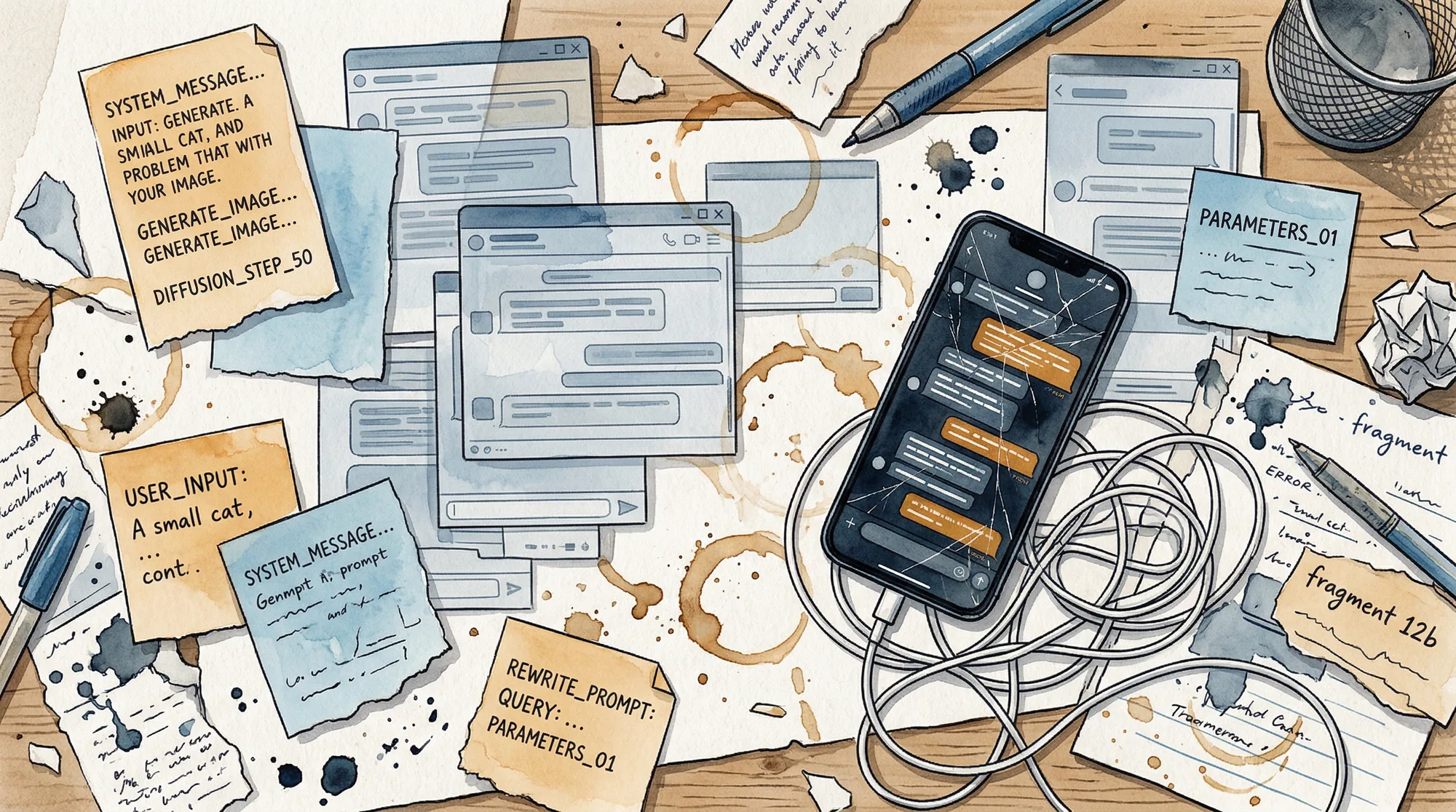
For basic roleplay, honestly? It's not terrible. You can get a decent 15-minute practice session. You can test your talk track against a fictional sceptic. You can even get passable email copy.
But that's where it ends. Because every time the rep opens a new chat window, everything resets. The "coach" doesn't remember that the rep struggled with the same pricing objection three calls ago. It doesn't know the rep's pipeline is stalling at stage 2. It doesn't know the methodology the rep is supposed to be executing.
It knows whatever the rep types into the box. Nothing more.
The three things a prompt can't do
Here's where DIY coaching falls apart. Not because reps are doing it wrong, but because the architecture has a ceiling. And that ceiling is low.
No memory. A ChatGPT conversation is stateless. Every new session starts from zero. Your rep's vibe-coded coach doesn't remember that they lost a deal last Tuesday because they forgot to quantify business impact. It doesn't remember the coaching it gave them yesterday. It has the long-term memory of a goldfish with amnesia. (Sorry, couldn't resist.)
No context. A prompt doesn't know the sales methodology your organisation runs. It doesn't know Gap Selling from MEDDIC from SPIN. It doesn't have access to your CRM, your pipeline, or the specific deal your rep is working right now. It's coaching in a vacuum, and the vacuum is enormous.
No accountability. Nobody is measuring whether the rep improved. Nobody is tracking whether the coaching translated into a different behaviour on the next call. The rep could roleplay beautifully for an hour and then run a discovery call that completely ignores everything they practised. There's no feedback loop connecting the coaching to the outcome.
I hear this on calls every single week. Prospects tell me: "Our reps are building their own agents." And I always say the same thing.
You can. But unless you are Keenan, unless you are Julie Thomas, unless you're someone who has spent decades encoding a methodology into a coaching framework, you're limited in what it knows and how it acts. Because you don't know what you don't know.
That's not a criticism of the rep. It's a description of the architectural ceiling.
The danger nobody mentions: the model has no spine
Everything above is about what a prompt can't do. There's a harder problem underneath it, and it's the one that actually worries me.
A general-purpose LLM has no spine. No core thesis of what good selling is. No reasoning model tuned to the specifics of a deal. Ask it for sales coaching and it will give you something. Fluent, confident, immediate. But there is no point of view holding it up. It is averaging the entire internet's idea of sales advice and handing you the mean.
Think about how absurd this is in any other context. You wouldn't hire ChatGPT, give it an avatar, and pay it $300k to walk on stage at your January kickoff and tell your sales floor how to sell. You'd call that generic AI slop, and you'd be right. Yet plenty of those same businesses are perfectly relaxed about reps quietly self-solving with exactly that tool, to decide what to say to a real customer on a real deal that real revenue depends on. It's the same advice. It's just whispered into a chat window instead of shouted from a stage, so nobody clocks it.
Now combine that lack of spine with how these models are trained. RLHF tunes a model to be agreeable, to please the person asking. The model is not aware of its own limitations. And here's the trap: if the rep isn't aware of those limitations either, and by definition they aren't, because they only opened the chat window in the first place because they didn't know what to do, then nothing in the loop catches the error.
The model can't tell it's wrong. The rep can't tell it's wrong. So the model does what RLHF trained it to do. It validates. It reframes whatever the rep was already leaning towards as a smart, decisive move. The rep walks away from the conversation feeling like a genius.
That feeling is the problem. It's not coaching, it's reassurance. The rep didn't get better, they got comfortable. And they'll do the same thing on the next deal, and the one after that, because the experience felt great every time.
Multiply that across a quarter and you get bad habits hardening, expectations drifting, and customer outcomes quietly getting worse, all under the illusion of efficiency. Worst of all, it makes the enablement and commercial leaders' job harder, not easier. You can't correct behaviour the rep is convinced is already working. The DIY coach didn't just fail to help. It built a wall in front of the people whose actual job is to help.
A real coach has a spine. It will tell the rep the move they were about to make is wrong, even when the rep doesn't want to hear it, because it is anchored to a methodology and a thesis of what good looks like. That friction is the entire point. A model trained to please you will never give it to you.
Why 95% of AI pilots fail (and what the 5% did differently)
MIT's GenAI Divide report (2025) put a number on this. Across $30-40 billion in global generative AI investment, 95% of AI pilot programmes fail to deliver any measurable ROI. That's not a marketing stat from a vendor blog. That's MIT, surveying 350 employees and analysing 300 public AI deployments.
But here's the finding everyone glosses over. Vendor partnerships succeed 67% of the time. Internal builds? One-third as often.
Read that again. When companies buy a purpose-built tool from someone who has encoded the expertise, it works two-thirds of the time. When they try to build it themselves, they fail two-thirds of the time. The success rate literally inverts depending on which path you take.
This maps perfectly to the DIY AI coaching trend. A rep vibe-coding their own coach is an internal build. They're starting from their own knowledge, their own prompts, their own mental model of what good coaching looks like. And unless they happen to be a methodology expert and a prompt engineer and a sales coach (all simultaneously), they're building a worse version of something that already exists.
The 5% that succeeded had something in common. They didn't try to change what reps know. They changed what reps do. The coaching wasn't a separate activity. It was embedded in the work itself.
The model is simple. Where a rep is exposed on a deal, the AI applies the methodology at high fidelity and does more of the work: it writes the email, preps the call, runs the deal review, so the rep sees what good looks like on the real thing. Where the rep is strong, it pulls back to a sharp question. The rep learns by working real deals with that support, not by sitting through a course. That's not training. That's an apprenticeship. And it's the only model that consistently closes Performance Drift: the growing gap between what reps learn in training and what they actually execute in the field.
What real coaching architecture looks like
So if a prompt isn't enough, what is?
Persistent memory across sessions. The coach remembers every deal, every coaching conversation, every win and every loss. When the rep opens the tool on a Tuesday morning, it already knows what happened on Monday's call and what to focus on next.
Methodology-specific intelligence. Not generic "be more consultative" advice. Actual Gap Selling logic, or ValueSelling frameworks, or MEDDIC stages, built into the coaching brain by the people who created those methodologies. The coaching isn't just good. It's correct.
Integration into the actual workflow. The rep doesn't go to the coach. The coach comes to the rep. When they're writing an email, the coach is there. When they're prepping a discovery call, the coach has already pulled the context. When a deal stalls, the coach flags it before the manager even notices.
Accountability loops. Scorecards. Performance tracking. Trend analysis. The coaching isn't a one-off conversation that disappears into the ether. It's a system that measures whether the rep's behaviour actually changed on the next real call.
This is what separates architecture from prompts. A prompt is a single instruction. Architecture is a system that learns, remembers, adapts, and holds people accountable. The difference isn't incremental. It's structural.
Docebo's own data makes this point inadvertently: 79% of organisations have adopted AI tools, but only 9% have transformed how work actually gets done. The other 70% bolted AI onto the same broken processes. And that, incidentally, is exactly what a vibe-coded prompt does. It bolts AI onto the same broken coaching process, just faster.
The signal your reps are sending you
If your reps are building their own AI coach, don't panic. And definitely don't ban it.
Listen to what they're telling you. They want coaching. They want it now. They want it specific to their deals, relevant to their role, and available when they need it, not when L&D scheduled the next webinar.
That's not a problem. That's a product requirement.
Stop asking whether your reps should be coaching themselves with ChatGPT. Start asking why the tools you gave them were so irrelevant that ChatGPT seemed like an upgrade. If you're weighing the alternative, our complete guide to AI sales coaching covers what a purpose-built coach does that a prompt can't.
Give them a coach that remembers. Give them a coach that knows the methodology. Give them a coach that lives in the work. And they'll stop building their own.
Ready to see what real AI coaching looks like? Replicate Labs gives reps, managers, and entire sales teams access to high-quality AI coaching, built on proven methodologies, with persistent memory and deal-level context. No prompt engineering required. No subscriptions to get started. Try it free at replicatelabs.ai →
Frequently Asked Questions
Should sales reps build their own AI coach with ChatGPT?
For basic roleplay practice, it can work as a supplement. But DIY approaches lack memory, methodology context, and accountability. MIT research (2025) shows internal AI builds succeed only one-third as often as vendor partnerships, which achieve 67% success rates. The architectural limitations matter more than the prompt quality.
What's wrong with using ChatGPT for sales coaching?
ChatGPT is stateless. Every new conversation starts from zero with no memory of previous coaching, no knowledge of your pipeline, and no connection to your sales methodology. Docebo (2026) found that 79% of organisations adopt AI tools but only 9% transform how work gets done. The tool isn't the problem. The architecture is.
What is DIY AI sales coaching?
DIY AI sales coaching is when individual reps create their own coaching setups using general-purpose AI tools like ChatGPT, Claude, or custom GPTs. They write prompts to simulate buyers, get feedback on calls, or draft outreach. The trend is accelerating as 85% of employees say formal training lacks relevance to their actual role (Docebo, 2026).
How do AI sales coaching platforms differ from ChatGPT prompts?
Purpose-built platforms offer persistent memory across sessions, methodology-specific coaching logic (Gap Selling, ValueSelling, MEDDIC), CRM integration, performance tracking, and accountability scoring. ChatGPT offers a blank text box. The difference is the same as the difference between a personal trainer who tracks your progress and a YouTube workout video you found at midnight.
Why do most AI coaching pilots fail?
MIT's GenAI Divide report (2025) found that 95% of generative AI pilots fail to deliver ROI. The primary driver is implementation approach: teams that try to build internally fail far more often than those that partner with specialised vendors. The 5% that succeed focus on changing rep behaviour in the workflow, not delivering more content or training modules.