
Your best sales coach used to be whichever manager happened to be free on a Tuesday.
If the deal was hot, you got an hour. If the rep was new, maybe 30 minutes. If the manager was slammed with their own number, their own board deck, their own 1:1s, you got a Slack emoji and "let's circle back Friday." Friday never came.
That's not a coaching model. That's a scheduling accident.
And it's the model every tech sales org I know has been running on for the last decade. Nobody designed it. It just settled into place, the way water settles into the shape of whatever container you pour it into. The container, in this case, was a frontline manager with eight to twelve reps, their own quota, and twenty-four hours in a day like everyone else.
So let me introduce you to the thing that's about to change that. Not a replacement for your manager. Something your manager never had the hours to be.
The real problem isn't "is AI coming for coaches"
The debate in every sales ops Slack right now is whether AI can replace human sales managers. Wrong frame. AI isn't replacing the coach who sits down with a struggling rep and works out whether they're burnt out or just in the wrong seat. That coach is irreplaceable.
AI is replacing the thing that was never happening in the first place: consistent, in-the-moment, deal-level coaching on every call, every email, every opportunity, for every rep, every day.
That coaching layer doesn't exist in most orgs. It never did. There was never enough manager time to make it exist.
Let me prove it with arithmetic, because this is the kind of claim that deserves more than an assertion. Take a frontline manager with ten reps. Each rep runs, conservatively, ten meaningful sales conversations a week: discovery calls, demos, negotiation calls, the lot. That's a hundred conversations a week landing under one manager. A working week is roughly forty hours. If that manager did nothing else, nothing, no forecasting, no hiring, no escalations, no 1:1s, no carrying their own number, they could give each of those hundred conversations twenty-four minutes. Twenty-four minutes to prep it, observe it, and debrief it.
They don't have twenty-four minutes. They have a fraction of that, and most of it goes to the three reps who are either on fire or on the edge of being managed out. The other seven get coached the way the weather gets discussed: occasionally, in passing, and with no real effect on what happens next.
The coaching most sales orgs think they're buying has never actually been delivered. Not because managers are lazy. Because the maths was never going to work.
So we're not talking about automating something humans used to do well. We're talking about installing something that was always supposed to be there and never was.
What "always-on" actually means
When I say AI coaching layer, I don't mean a chatbot that congratulates reps for closing a deal. I mean something more specific:
- Every discovery call gets reviewed against your methodology the same day it happens
- Every email draft gets pressure-tested before it goes out
- Every deal in the pipeline gets gap-checked against what it actually needs to close, not just what's in Salesforce
- Every rep has a coach on hand at 9pm the night before the big demo
This isn't sci-fi. This is the coaching your best manager does for their favourite three reps, extended to the other 47.
The shift isn't more coaching. It's coaching that shows up whether or not a human is free on Tuesday.
And the word that matters most in that sentence is consistent. A human manager coaching ten reps is, unavoidably, ten slightly different coaches. They're sharper in the morning. They're more generous with the rep they had lunch with. They half-remember what they told the team in January. An AI coach trained on your methodology gives rep number ten the same standard it gave rep number one, on a Friday afternoon, in week nine of the quarter. Consistency at scale isn't a nice-to-have. For an enablement leader trying to make a methodology actually stick, it's the entire job.
Why tech sales orgs are going first
Three reasons.
1. The data is already there. Gong, Chorus, Salesforce, HubSpot, Outreach. Your reps generate more structured sales data than any other function in the company. You don't need to instrument anything new. You need something that reads it. A tech sales org that has spent four years and a serious budget wiring up its revenue stack is sitting on the richest coaching input set in the building, and almost none of it is being turned back into coaching. It's being turned into dashboards nobody opens.
2. Ramp time is the cost centre. Every month a tech AE is in ramp is a month they're not carrying quota. Faster ramp is worth more to a tech sales org than almost any other investment. AI coaching compresses ramp because it front-loads the reps' exposure to methodology before they face a real buyer. One customer, a spend-management platform, measured a threefold improvement in ramp time after embedding AI coaching into onboarding. Put a number on that for your own org: take your fully-loaded AE cost, multiply by the months you currently lose to ramp, multiply by headcount. The figure tends to be uncomfortable, which is the point.
3. Your reps are technical enough not to fight it. Tech AEs don't flinch at software. They flinch at bad software. Give them a coach that's genuinely useful on their live deals and they'll use it. Give them dashboards and sentiment scores and they'll roast you in #sales-chat. This is the cohort most likely to adopt a tool voluntarily, and voluntary adoption is the only kind that survives contact with a busy quarter.
"We've heard this before", and the three objections that follow
If you've run enablement for any length of time, a claim like "every rep gets coached on every deal" should make you suspicious. You've bought tools that promised behaviour change and delivered a login screen. So let me take the three objections head-on, because if I were you I'd be holding all three.
"Our reps won't use another tool." This is the right objection, and it's usually correct. Most sales tools fail not because they're bad but because they sit outside the workflow. They're a tab you have to remember to open. The reason an execution-focused AI coach breaks that pattern is that it isn't a training module a rep completes to satisfy their manager. It's help with the deal in front of them tonight. We learned this the hard way: when we ran standalone AI coaching, fewer than 5% of reps showed measurable improvement. When we shifted from "let me coach you" to "let me help you close this deal," engagement changed completely. Reps come back because it's useful, not because it's mandated. That's the only adoption model that holds.
"Can't we just use ChatGPT for this?" You can use ChatGPT, and it'll give a confident, generic answer. Three things it can't do: it doesn't know your methodology, so it can't tell a rep their discovery skipped the cost-of-inaction step your playbook requires. It doesn't remember your reps, so every conversation starts from zero, with no memory of the deal you discussed last week. And it doesn't read your stack, so it's coaching in the dark on a deal it can't see. A purpose-built coaching layer runs three tiers: a base model, your methodology, and a personalised layer that remembers the rep and the deal. Generic AI has only the first.
"We already own Gong / Highspot / a readiness platform." Good. Keep them. An AI coaching layer doesn't replace the tools that record calls or store content. It connects to them. Gong records what happened on the call. The coaching layer tells the rep what to do before the next one, and pressure-tests the follow-up after. Your existing investments become inputs to the coaching, not competitors with it.
None of these objections is wrong. They're the scar tissue of a decade of shelfware. The answer isn't to dismiss them. It's to buy on the one criterion that predicts whether any of this works: do reps come back to it without being told to?
What Replicate Labs is actually building
Replicate Labs builds named AI coaches, each one trained on a specific methodology and voice. Keenan for Gap Selling. Others for the frameworks your org already runs on.
A rep can open Keenan before a discovery call and rehearse the questions they're about to ask. They can open him again after the call and get a second read on what the buyer actually said. They can draft the follow-up email in his voice and have him push back on anything that sounds like fluff.
That's what I mean by "meet your AI coach." Not a feature in a tool. A named coach, with a point of view, who shows up for every call on every deal, and hands back to the human manager the moment the conversation stops being about methodology and starts being about the rep themselves.
And it isn't one coach working alone. Behind Keenan sits a small team of AI managers, each with a job. Bryce reads the usage and the patterns and tells a sales leader, in plain language, what the team actually needs this month, the conversational version of the dashboard nobody opened. The coaching that helps the rep and the analytics that help the leader run off the same memory. That matters, because the most common failure mode in enablement is the rep layer and the leadership layer disagreeing about what's wrong.
The hand-off is the whole point
Here's the part most people miss: this isn't a replacement play, it's a hand-off play.
Deal-level coaching → AI. It's consistent, analytical, and happens at scale.
Rep-level coaching → human manager. It's emotional, contextual, and matters more than ever.
When AI takes the deal layer, your frontline managers get hours back. Hours they spend on the stuff only a human can do: the career conversation, the confidence rebuild, the "what's really going on here" conversation that doesn't show up in call transcripts.
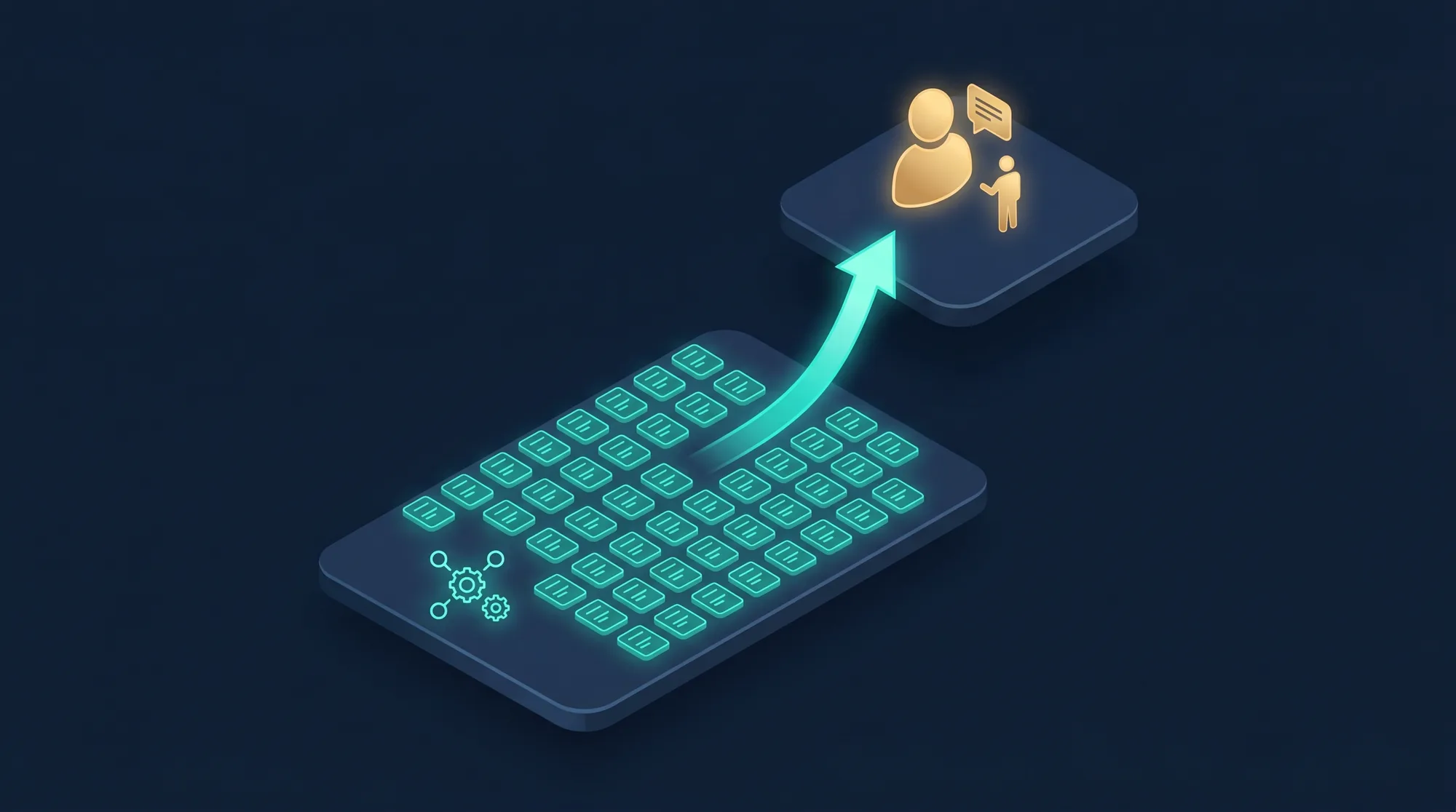
What makes that hand-off honest is that the AI meets the rep where they actually are on the deal in front of them, not where a curriculum says they should be. On a discovery the rep has run a hundred times, it stays light and just asks the sharp question. On the procurement conversation that rep has never faced, it does more of the work directly: drafts the email, builds the plan, shows what good looks like on this specific deal. Same rep, same week, two different levels of support, because the deals are different. It is not a fixed progression the rep climbs once. It is a coach reading the situation and dialling in. The goal isn't a rep permanently dependent on an AI. It's a rep who internalised the methodology because they were coached through real deals, not lectured at in a classroom. The AI's success metric is that, over time, the rep needs it less.
That's a better job for the manager. It's a better coaching experience for the rep. And it's the first time in a decade that a mid-market tech sales org can say with a straight face that every rep gets coached on every deal.
What this looks like 90 days in
So picture the org a quarter after you've installed it.
The new AE who started in week one has had every one of her discovery calls reviewed against your methodology, the same day, every day. She isn't waiting for her manager to find a free Tuesday. By week six she's running the cost-of-inaction question without being prompted, because she's been coached on it forty times, not once in onboarding.
The mid-tier rep who's been at quota-minus-ten for three quarters has had a coach quietly flagging the same gap on every stalled deal: he opens with the product, not the problem. His manager half-knew that. Now it's documented, specific, and being worked on every week instead of mentioned once a year in a review.
And the frontline manager has her Tuesdays back. She's spending them on the two reps who need a human, the career conversation and the confidence rebuild, instead of trying and failing to be twelve coaches at once.
That's not a productivity gain. It's a different operating model. The coaching layer that was always supposed to exist, finally does.
The next step
If you're running a tech sales org, the question isn't whether to install an AI coaching layer. The question is which methodology you want it trained on, and how fast you want it in front of your reps. If you're still weighing the first question, our complete guide to AI sales coaching covers it.
The era of coaching-by-scheduling-accident is over. The only question is whether your team is on the right side of that change before your competitors' reps are.
See what it looks like for your team → replicatelabs.ai