"Customer churn." "Logo attrition." "Negative net revenue retention." Three names for the same thing: a customer left. But each one lands differently in a board meeting, and each one quietly nudges you toward a different fix. Rename a problem and you rename the solution.
The same thing happens with the gap at the heart of sales enablement. The name you give a problem shapes how you think about it, which shapes the product you build, which shapes whether it actually works.
Mindtickle called the problem the "Know-Do Gap." We call it "Performance Drift." Same problem. Completely different solutions.
The name matters more than you think.
What's the problem, actually?
Let's start with what everyone agrees on. There's a persistent gap between what sales reps know they should do and what they actually do in the field.
Every enablement leader has seen it. You run a training programme. The reps ace the quiz. They nail the certification. They can recite the methodology backwards. Then they get on a real call and do something completely different.
The training worked. The behaviour didn't change. That's the gap.
Mindtickle saw this gap and called it the Know-Do Gap. It's a clean, intuitive name, and it's diagnostically honest: the rep knows the thing, the rep doesn't do the thing. The gap sits between knowing and doing, not before knowing.
The trouble is what the rest of the industry does with that name.
The name shapes the diagnosis
A name like "Know-Do Gap" correctly puts the problem after knowledge. But the products built around it quietly drift back to treating it as a knowledge problem anyway, because knowledge is the thing enablement tooling already knows how to address.
So what gets built? A training platform. More content. More quizzes. More reinforcement. Spaced repetition. Micro-learning. Video practice with AI feedback.
To be fair to Mindtickle, they built that well. Their platform covers a lot: content authoring, readiness programmes, conversation intelligence, certifications. It's a proper training machine, and for genuinely new reps who haven't learned the methodology yet, that's exactly what you want.
But the Know-Do Gap, by its own definition, isn't a knowledge problem. The rep already knows. Pour more knowledge into a rep who already knows and nothing on a real call changes.
Reps know plenty
After 10+ years in sales enablement and coaching, I can tell you with confidence: most reps already know what they should be doing. The average B2B rep has been trained on discovery, objection handling, qualification, negotiation, and closing more times than they can count.
They know they should multi-thread. They know they should find the economic buyer. They know they should quantify the cost of inaction. They know they should send a recap email after every call.
They know. They just don't do it consistently when it matters.
And the reason isn't that they've forgotten the training. The reason is that in the middle of a complex deal, with 6 stakeholders, a competitor breathing down their neck, and a quarter-end target looming, the textbook goes out the window.
That's not a knowledge gap. That's a performance gap. And the distinction changes everything.
Test it on your own team
Don't take my word for it. Run a 60-second experiment with your own reps.
Pull your bottom-quartile performer into a room and ask them to talk you through, out loud, exactly how they'd qualify a stalled enterprise deal. Don't help them. Just listen.
I'd put real money on this: they'll give you a textbook answer. They'll talk about identifying the economic buyer, quantifying the cost of inaction, mapping the buying process, confirming a next step. The words will be right. The framework will be intact.
Now go and pull the call recordings from three of that rep's actual live deals. Listen to the discovery calls. Count how many of those things they actually did.
The gap between those two exercises, the perfect answer in the room and the messy reality on the recording, is the entire problem. It is not a hole in what the rep knows. It's a hole in what the rep does under pressure. And if more training could close it, it would have closed already, because that rep has sat through more training than you'd believe.
You cannot train your way out of a problem that isn't made of missing knowledge.
Performance drift: a different name, a different diagnosis
We call it Performance Drift because it describes what actually happens more accurately.
Performance Drift is the gradual, deal-by-deal erosion of best-practice execution that occurs when reps operate without regular coaching reinforcement. It's not that they don't know what to do. It's that without someone (or something) keeping them on track, they drift.
They stop multi-threading because it's easier to rely on the one champion who's responsive. They skip quantifying the cost of inaction because the deal seems to be moving anyway. They don't send the recap email because they're already on to the next call.
Each drift is small. Each one is rational in the moment. And compounded over a quarter, they're devastating.
The name "Performance Drift" implies an execution problem, not a knowledge problem. And execution problems require a fundamentally different solution.
Why the word "drift" is doing real work
I want to defend that specific word, because it isn't decoration. It carries the whole diagnosis.
"Drift" tells you three things a phrase like "Know-Do Gap" can't.
First, it tells you the problem is gradual. A gap is a static thing, a hole you either fall into or you don't. Drift is a process. It happens a little at a time, and that matters, because it means there's no single dramatic moment where a rep "forgets" the methodology. There's just a slow slide, deal by deal, that nobody notices until the quarter's results are in.
Second, it tells you the problem is invisible in the moment. When you're drifting, you don't feel it. Each individual decision feels fine. Skipping the cost-of-inaction question on this one call feels rational, the deal's moving, why slow it down. Leaning on the one responsive champion instead of multi-threading feels efficient. Every micro-decision is defensible on its own. It's only when you sum them across a quarter that the picture turns ugly. That's why reps genuinely don't realise they've drifted. They were never wrong, exactly. They were just slightly off, repeatedly.
Third, and most importantly, it tells you the cure. You don't fix drift with a one-time correction, because the drift will simply start again the next day. A ship that's drifting doesn't need a lecture on navigation. It needs a hand on the tiller, regularly, nudging it back on course. That's not training. That's coaching. And it has to be frequent, because drift is frequent.
Name the problem "gap" and you reach for a thing that fills holes: content. Name it "drift" and you reach for a thing that makes constant small corrections: a coach. The word chose the product before anyone wrote a line of code.
Different diagnosis, different product
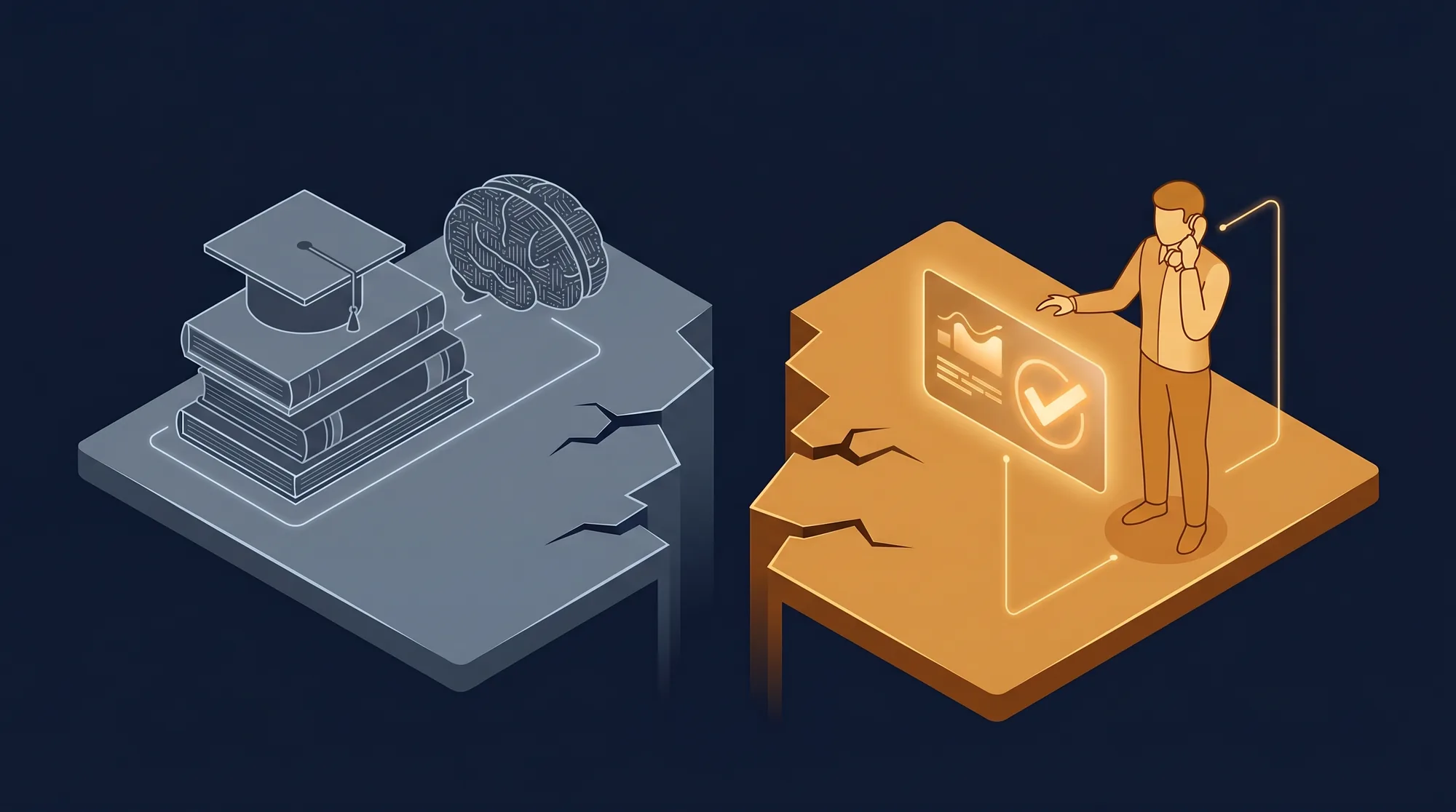
If the problem is a Know-Do Gap (knowledge problem), you build a training platform:
- More content delivery
- More reinforcement and repetition
- More assessment and certification
- More practice environments
- More readiness scorecards
If the problem is Performance Drift (execution problem), you build a coaching platform:
- Real-time guidance on live deals
- Pattern detection across the pipeline
- Intervention when drift is happening, not after
- Coaching availability every day, not every quarter
- Feedback loops tied to actual outcomes, not quiz scores
Mindtickle built the first list. We built the second.
Both are legitimate responses to a real problem. But they solve different versions of that problem, and the version your reps are actually experiencing determines which one works.
Why this matters for buyers
If you're an enablement leader evaluating tools right now, the most important question isn't "which platform has more features?" It's: "What's actually going wrong with my team?"
If your reps genuinely don't understand the methodology, if they're new, if they're missing foundational knowledge, then you have a knowledge problem, plain and simple. Training is the right answer. Mindtickle is a reasonable choice.
But if your reps can explain MEDDIC perfectly in a training session and then forget to identify the economic buyer on a real deal, that's the actual Know-Do Gap, and it's not a knowledge problem. They know. They're not doing. That's Performance Drift. And no amount of additional training will fix it, because there's no missing knowledge to add.
You don't solve drift with more curriculum. You solve drift with more coaching. And how AI sales coaching works is precisely the model built to deliver that at the volume drift demands.
The industry's naming problem
Here's the broader point, and the reason I think this matters beyond just Mindtickle and Replicate Labs.
The sales enablement industry has a naming problem. We keep giving execution problems knowledge-sounding names, and then we build knowledge solutions.
"Skill gap" sounds like a training problem. It's usually a coaching problem.
"Readiness" sounds like a preparation problem. It's usually an in-the-moment support problem.
"Competency" sounds like an assessment problem. It's usually a consistency problem.
Every time we name a problem after its input (knowledge, skill, readiness), we build for the input. When we name it after its output (performance, execution, results), we build for the output.
I'd rather build for the output.
The honest admission
I'll be straight with you (not that I have any other setting): I don't think Mindtickle is a bad product. They've built a genuinely impressive training platform. If I were onboarding 200 new reps, I'd want something like it in the stack.
But I do think the name gets stretched to cover two different audiences that need opposite things. The reps who need a training platform most are the ones who don't know the methodology yet. The reps who need Replicate Labs most are the ones who know it cold and still aren't doing it under pressure, the real Know-Do Gap.
And in my experience, there are a lot more of the latter than the former.
The name you give the problem shapes the product you build. Choose the name carefully.
Performance Drift is an execution problem, and it needs a coaching solution. Replicate Labs gives reps AI coaching on live deals, every day, so drift doesn't compound into lost revenue. Start free at replicatelabs.ai, whether you're a rep, a manager, or running a whole team.