
I'm pretty rubbish at poker. I know the rules, I understand the theory, but the second someone at the table starts bluffing with confidence, I fold. I can't tell the difference between someone who actually has a hand and someone who's just really good at pretending.
The sales enablement industry has a poker problem right now. Every vendor at the table is going all-in on "agentic AI." They're pushing their chips forward with absolute confidence. And most of them are bluffing.
The word everyone is using
Open any enablement vendor's website right now. Go on. I'll wait.
You'll find "agentic" on the homepage. In the product description. In the latest blog post. In the press release. It's everywhere. Gong is agentic. Highspot is agentic. Seismic is agentic. Everyone, it seems, woke up one morning and became agentic.
Except most of them didn't. They just changed the label.
"Agentic AI" has become the "blockchain" of 2026. A word that means something very specific in computer science but has been diluted into meaninglessness by marketing teams who need a fresh buzzword now that "AI-powered" sounds boring.
What "agentic" actually means
Let's be precise, because precision matters here.
In AI, an agentic system has a specific set of characteristics:
1. Autonomy. The system takes actions without being told exactly what to do at each step. It receives a goal and figures out how to achieve it.
2. Persistence. The system maintains context and state across interactions. It remembers what happened, what worked, what didn't, and adapts its approach accordingly.
3. Tool use. The system can access and use external tools, data sources, and systems to accomplish its goals. It doesn't just generate text. It does things.
4. Reasoning. The system can break down complex goals into sub-tasks, prioritise them, and handle unexpected situations without falling back to a human for every decision.
5. Proactive behaviour. The system doesn't just respond to prompts. It identifies opportunities, flags issues, and takes initiative when appropriate.
That's what agentic means. Not "chatbot." Not "AI assistant." Not "smart search with a conversational interface."
The reality check
Now let's look at what most "agentic" enablement tools actually do.
The "agentic" content platform: You ask it to find a relevant case study. It searches a content library and returns results. You review them, pick one, maybe ask it to summarise. The AI did a search. That's not agentic. That's a search engine with a chat interface.
The "agentic" coaching tool: You open it, select a scenario, do a practice role-play, and get feedback. Every step is initiated by you. You chose the scenario. You started the session. You decided when to stop. The AI responded to your inputs. That's a chatbot doing role-play. A good chatbot, maybe. But not an agent.
The "agentic" call intelligence platform: It records your calls, transcribes them, and generates a summary with action items. You review the summary and decide what to do. The AI processed audio and generated text. That's transcription with analysis. Not agentic.
The "agentic" enablement suite: It recommends training content based on rep performance data. A manager reviews the recommendations and assigns modules. The AI made a recommendation. That's a recommendation engine. Not agentic.
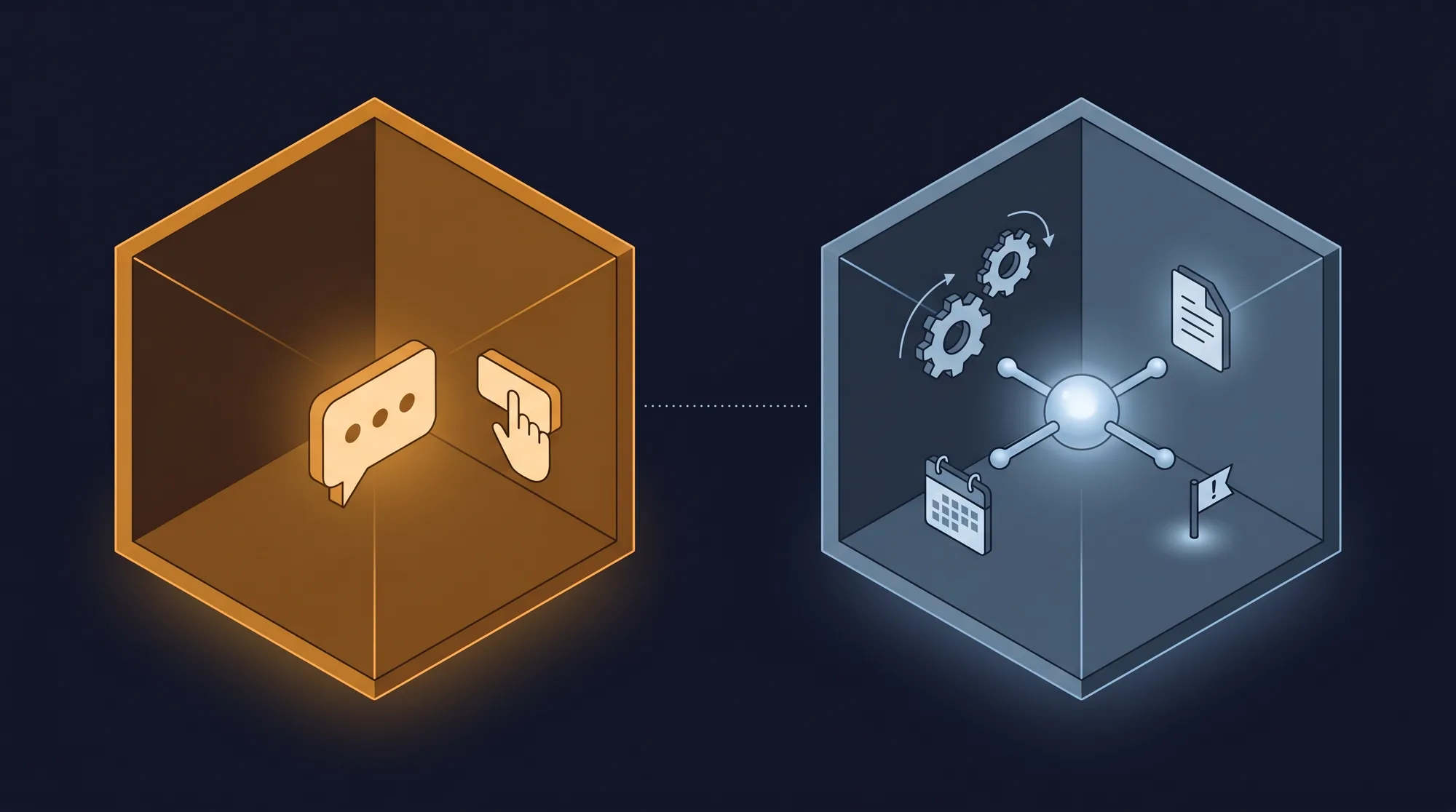
In every case, the human initiates, configures, reviews, and acts. The AI responds, generates, or recommends. That's not agentic. That's reactive with extra steps.
Why the distinction matters
You might be thinking: "Who cares what it's called? If it works, it works."
Fair point. But here's why the labelling matters.
1. It sets wrong expectations. When a vendor sells you "agentic AI," you expect the system to do things autonomously. When it turns out you still need to configure every workflow, review every output, and initiate every interaction, you feel misled. And you should.
2. It distorts buying decisions. If every vendor claims to be agentic, the word loses its ability to differentiate. Buyers can't tell who's actually building autonomous systems and who's relabelling last year's chatbot. That makes procurement harder, not easier.
3. It delays real innovation. If the market accepts "chatbot with a chat interface" as "agentic," there's no incentive for vendors to build genuinely autonomous systems. Why invest in real agent architecture when you can just update your marketing copy and claim you've arrived?
What real agentic looks like in sales
Let me paint a picture of what genuinely agentic sales coaching looks like. Not what's being marketed. What's actually possible.
Scenario 1: Proactive call prep. An agentic coach sees a rep has a discovery call scheduled in 2 hours. Without being asked, it reviews the prospect's company, pulls relevant signals, identifies likely pain points, cross-references with deals the rep has won and lost in the past, and proactively suggests a coaching session focussed on the specific challenges this call is likely to present. The rep didn't initiate anything. The coach did.
Scenario 2: Continuous pipeline coaching. An agentic coach monitors a rep's pipeline and notices a deal has been stuck at the same stage for 3 weeks. Without being asked, it analyses the deal history, identifies what's missing (no champion identified, no technical evaluation scheduled, no business case built), and reaches out to the rep with specific coaching on how to unblock the deal. The manager didn't assign this. The coach identified the problem and acted.
Scenario 3: Adaptive skill development. An agentic coach tracks a rep's performance across all coaching sessions and notices a pattern: they consistently struggle with price objections in the second meeting. Without being asked, it creates a personalised coaching programme specifically targeting that gap, schedules sessions at optimal times, and adjusts the difficulty based on the rep's progress. No enablement team designed this programme. The coach built it from observed behaviour.
That's agentic. The AI has a goal (improve rep performance), takes autonomous actions to achieve it, uses tools and data to inform its decisions, maintains context across interactions, and acts proactively without waiting for a human to press the button.
The bluffing test
Here's a simple test you can run on any vendor claiming to be agentic. Ask them these three questions:
1. "What does your system do without being asked?" If the answer is "nothing until the user initiates," it's not agentic. It's reactive.
2. "How does your system adapt its behaviour based on what it learns?" If the answer is "it recommends different content based on performance metrics," that's a recommendation engine. If the answer is "it autonomously modifies its coaching approach, creates new practice scenarios, and adjusts difficulty based on observed patterns," that's agentic.
3. "Can your system take actions across multiple tools and systems without human intervention?" If the answer is "it can surface insights from your CRM," that's an integration. If the answer is "it can update deal records, schedule coaching sessions, flag at-risk deals, and notify managers, all autonomously based on its own analysis," that's agentic.
Most vendors will struggle with all three. Because most vendors aren't building agents. They're building chatbots and calling them agents.
Running the test in a real evaluation
The three questions are useful, but a sharp vendor will have rehearsed answers to all of them. So here is how to actually run the test in a procurement process, where rehearsed answers fall apart.
Don't ask the vendor to describe their product. Ask them to show you a thing that already happened. Specifically: "Open the system. Show me one action it took in the last seven days that no human asked it to take." Watch what happens.
A genuinely agentic system has an audit trail of self-initiated actions: deals it flagged, coaching sessions it scheduled, gaps it surfaced, reps it nudged, all with timestamps and no human in the trigger. The vendor can scroll through it. A relabelled chatbot has none of this, because every action in its history starts with a user clicking something. The salesperson will pivot to the roadmap ("that's coming in Q3") or to a hypothetical ("imagine it could..."). The pivot is the answer. If the autonomy only exists in the future tense, it does not exist.
Second test, for the procurement-minded: ask to see the same system used by two different reps and compare the coaching each one received last month. An agentic coach adapts. The two reps should have measurably different coaching histories because they have different gaps. If both reps got the same content in the same order, you are looking at a content library with a schedule, not an agent. The label says "personalised." The audit trail says "playlist."
Third, the one that exposes the most bluffs: ask what the system did when it was wrong. Genuine agents act, observe the outcome, and adjust. So there should be cases where the coach pushed a rep toward a next step, the step didn't work, and the coach changed its approach. If the vendor cannot point to a single instance of the system correcting its own course, it is not reasoning toward a goal. It is executing a script, and scripts do not have a concept of being wrong.
None of these three can be answered with marketing copy. That is the point. You are not asking the vendor to describe agency. You are asking them to produce the evidence of it, and evidence either exists in the product or it doesn't.
What real agentic coaching actually requires
There is a deeper reason the distinction matters, and it goes past procurement hygiene.
The whole value of an agentic coach is that it can do the work first and hand it back as the rep is ready for it. Where a rep is exposed on a deal, the coach does the execution work for them, drafts the email, builds the call plan, frames the discovery, so the rep sees what good looks like on their actual deal, not in the abstract. Where the rep is already strong, the coach reviews and corrects, or just asks the sharp question and steps back. The level of support is matched to the rep and the deal, in the moment, not handed out on a fixed schedule.
That is impossible for a reactive chatbot. A chatbot cannot do the work first, because it does nothing until you prompt it. It cannot tell that a rep is strong on discovery but exposed on procurement, because it has no model of the rep's capability and no memory of their last twenty interactions. It cannot step back, because it was never stepping forward. A chatbot has exactly one mode, and that mode is "wait."
So when a vendor says "agentic" and means "chatbot", they are not just overclaiming on a spec sheet. They are selling you a product that structurally cannot do the thing that makes agentic coaching valuable in the first place. The autonomy is not a nice-to-have feature on top of the coaching. The autonomy is what allows the coaching to transfer capability instead of just dispensing advice. Take the agency away and you are left with a search box that talks.
The honest position
I'll be transparent about where Replicate Labs sits on this spectrum, because the bluffing test cuts both ways and I'd rather be measured by it than hide from it.
Run the three procurement questions on us. The coaches maintain context across every session, so they remember what a rep struggled with last week and adjust this week. They adapt their approach to the individual rep's patterns rather than running everyone through the same sequence. They flex the level of support to where each rep is on the specific deal, which by definition requires a model of where each rep currently sits. That is real, in production, and you can see it in the audit trail rather than the roadmap.
Where am I not going to overclaim? The fully autonomous scenarios from earlier in this post, the coach that books its own sessions and updates deal records across systems without anyone in the loop, are a direction of travel, not a finished claim. Some of it is live, some of it is being built. I would rather tell you that plainly than put "fully autonomous" on a homepage and watch a buyer feel misled six weeks into a contract.
The difference is not that we are perfectly agentic and everyone else is bluffing. The difference is that the coaching works today, reps use it without being forced to, and it measurably changes what they do on real calls, and we are building toward genuine agency from a product that already delivers. If you want the substance behind the buzzword, here is what AI sales coaching actually is. What I won't do is slap "agentic" on the marketing and hope nobody looks under the bonnet, because the moment a buyer does, that bluff costs you the deal and the trust behind it.
The real question
The enablement industry has a credibility problem. Years of overpromising and underdelivering on technology. "AI-powered" became meaningless. "Intelligent" became meaningless. And now "agentic" is going the same way.
The real question isn't "Is this tool agentic?" It's: "Does this tool actually make my reps better at selling?"
If it does, great. Call it whatever you want. But if the only thing that's changed is the marketing copy, and the product still requires a human to initiate, configure, and review everything, then it's not agentic. It's a chatbot wearing a nicer suit.
Call the bluff. Check the hand. The chips are too expensive to lose on a rebrand.
Skip the buzzwords. Try coaching that actually works. Replicate Labs gives reps and managers free access to AI sales coaches that measurably change selling behaviour. No jargon. No gimmicks. Just practise, feedback, and improvement. Get started free at replicatelabs.ai.