

My Dad had surgery recently. General anaesthesia, the works. He woke up groggy, could barely see straight, and the first thing he did was grab his phone and complete his Duolingo streak.
That's what a product with real pull looks like. Nobody told him to do it. Nobody mandated it. He just wanted to.
Now imagine a company buys 300 people access to an AI coaching tool. Free, no strings, no manager breathing down their neck. Three weeks later, the adoption dashboard looks terrible.
But here's what most people would miss: that tool had incredible pull with the people who actually needed it. The deployment model just buried it.
The product wasn't the problem. The way B2B organisations roll out software was.
The numbers that almost fooled me
Let me walk you through what happened, because the data tells two very different stories depending on which lens you use.
300 people signed up. That bit was easy. It was free, and I'd positioned it well. Of those 300, just over 100 came back more than once. About 40 used it enough to hit the free tier limit. And the number who converted to a paid plan off the back of all that?
Barely any. Close to zero.
If I'd been reporting this to a board, or to an enablement leader who'd just bought the tool for their team, the conclusion writes itself: low adoption, poor engagement, failed initiative. Rip it out, try the next vendor.
But that's the wrong story.
The right story is that 100+ people came back voluntarily. Nobody told them to. 40 people used it so much they ran out of free credits. And across roughly 10,000 interactions, only 7 were roleplays.
Think about that for a second.
10,000 events. 7 roleplays.
These people weren't logging in to practise. They were logging in because they were stuck. Stuck on a deal. Stuck on an email. Stuck prepping for a call that was 20 minutes away. They weren't training. They were working.
And that distinction, between training and working, is where the whole measurement falls apart.
Welcome to the Duolingo Trap
Here's the thought experiment I keep coming back to.
Take Duolingo. By any reasonable measure it is one of the best, stickiest consumer products ever built. Over 100 million monthly actives. Streaks that survive holidays, surgery, general anaesthesia. If you judged it on its own users, you'd call it close to a perfect product.
Now take that exact same product, unchanged, and deploy it into an organisation. A GTM team. Buy 300 sales reps a Duolingo licence. Announce it at the all-hands: "We're investing in your development, download the app, start your streak."
Three months later you pull the usage. It's a graveyard. A handful of people opened it twice. Daily actives in single figures. And the leadership read writes itself: "Duolingo doesn't work. Worst rollout we've done."
Same product. World-class by one measure, worst-thing-ever by the other. Nothing about the software changed. The only thing that changed is whether the people receiving it had any innate reason to want it.
That's the Duolingo Trap. A product's success is not a property of the product alone. It's a property of the product meeting a population that's actually motivated to use it. Move a brilliant product to a population without that motivation and it instantly looks broken.
This is the core flaw in the "Field of Dreams" rollout: build it, deploy it, and assume that because there's a plausible match between tool and team, they'll come. They won't. A plausible match is not intrinsic motivation. Those 300 reps weren't trying to learn Spanish. There was no trip to Barcelona, no move to Tokyo, no personal stake. You handed them a great tool and zero reason to open it.
The push problem
The enablement industry is built on push. Company buys tool. Company announces tool. Company mandates usage (or, more commonly, "strongly encourages" it, which everyone correctly interprets as optional). Company measures logins. Logins decline. Company blames tool. Rinse, repeat.
I've lived this cycle from both sides (buying the tools and building them). And the maths never works. Let me prove it.
A sales team of 50 reps. You roll out an AI coaching platform. Let's be generous and say 60% log in during the first week (that's actually high; most vendors will tell you privately that Week 1 activation is closer to 30-40%). By Week 4, you're down to 20% logging in at least once. By Month 3, you've got maybe 8-10 regulars.
The enablement leader looks at this and sees failure. The vendor looks at this and blames the enablement leader for not driving adoption. The reps look at both of them and think: "I've got 47 emails to send and a pipeline review in an hour. I don't have time to role-play with a chatbot."
Everyone's right. And everyone's wrong.
The tool probably works fine. The reps probably would benefit from it. The enablement leader probably did their best to roll it out. But the deployment model was broken from the start, because it relied on reps doing something they didn't ask to do, at a time that wasn't convenient, for a benefit they couldn't see yet.
That's push. And push doesn't scale.
The coaching gap is real. But not where you think.
MySalesCoach published their State of Sales Coaching report this year, and the numbers are grim.
41% of sales reps say they're never or rarely coached. 45% rate the quality of coaching they receive as below average, up from 29% the year before. Meanwhile, 64% of sales leaders believe they're coaching more than ever.
Read those together. Leaders think they're coaching more. Reps say the coaching is getting worse. Someone's lying, or (more likely) nobody's measuring the same thing.
And here's the kicker: only 34% of sales leaders have ever received any formal training on how to coach.
So we've got untrained coaches, coaching more often, delivering worse results. And the industry's answer is to buy AI tools and push them at reps who already feel over-coached and under-helped. It's the same reason everyone agrees training is broken and nobody has fixed it.
Sound familiar?
Pull changes everything
When I looked at the data from those 300 users properly (not the dashboard summary, the actual usage patterns) something clicked.
The people who became power users, the ones who hit the limit, who came back day after day, almost all started the same way.
They had a stuck deal.
Not a training goal. Not a manager telling them to log in. Not a certification deadline. A deal. A real one. With a real buyer who'd gone quiet, or a discovery call they'd botched, or an email they couldn't get right.
They came to the tool with a problem. The tool helped them solve it. They came back with the next problem. And the next.
That's pull. And in the data, pull looks nothing like push.
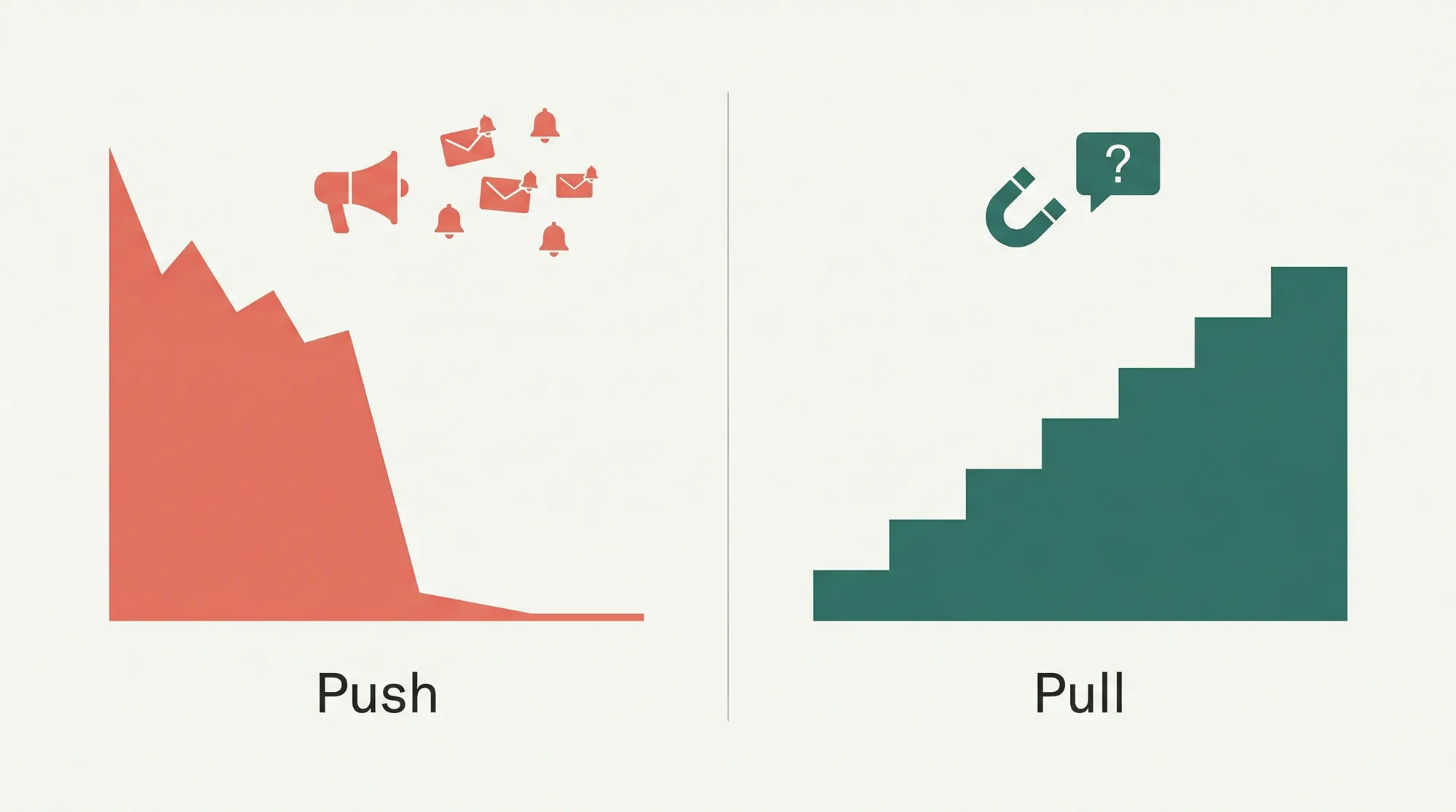
Push adoption looks like a cliff. High activation in Week 1, steep decline, long tail of nobody logging in. Pull adoption looks like a staircase. Low initial numbers, but each user who arrives actually stays, and usage compounds.
Pull looks worse in the first month and better in every month after that. But most companies measure at Month 1 and make their decision.
Here's the frustrating bit. Gartner forecasts that by 2026, over 70% of leading sales organisations will embed AI coaching into their workflows. The market is there. The intent is there. Teams using AI coaching tools are seeing 24% higher win rates. The technology is proven. But the deployment playbook hasn't caught up. Most organisations are still running the push model from 2019, just with fancier tools.
Be honest about which tools clear the bar
Here's the uncomfortable part for enablement.
A small number of tools genuinely can survive a cold rollout, because reps are intrinsically motivated to use them. If 90% of your GTM org is already saying, unprompted, "I want to do an AI roleplay before every big call," then a roleplay tool will get used. The motivation is already in the room. You just have to not get in its way.
But that is the exception, and you should be ruthless about identifying it. Most enablement, training, readiness, and forecasting software is not something a rep wakes up wanting to use. Nobody is intrinsically motivated to update the forecast or complete the readiness module. Mandate that category and you get the Duolingo Trap every time: a fine product that looks like the worst product in the world, because you deployed it into a population with no innate pull toward it.
So the first question isn't "is this a good tool." It's "do my reps actually want this, on their own, today?" If yes, deploy it and stay out of the way. If no, you do not have a rollout problem you can fix with a launch email. You have a motivation problem, and a tool cannot solve a motivation problem.
The fix is a programme, not a launch
If reps aren't innately motivated to use the thing, the answer is not to push harder. The answer is to build a programme around the product that connects its purpose to something reps are genuinely motivated by, short term and long term.
Short term: a stuck deal, a call tomorrow they're nervous about, a number they need to hit this quarter. Long term: getting better, earning more, being the rep who doesn't get coached because they don't need it. The product itself rarely speaks to those. A good programme makes the line from product to motivation explicit, and keeps making it.
That changes the framing entirely.
Instead of: "Here's a coaching tool. Go use it."
It becomes: "You've got a deal that's stuck. Let's fix it. The thing that just helped you? That's your coach. Come back with the next one."
The first is Duolingo-for-the-office, dropped on people with no reason to care. The second connects the tool to a problem the rep already has and a goal they already hold. That's the programme doing its job: getting reps through the door the first time, and giving them a reason to keep coming back.
At Replicate Labs, this is what we've been building towards. Where a rep is exposed on a deal, the AI does the heavy lifting: it writes the email, preps the call, structures the deal review, and the rep gets immediate value tied to work they actually care about. Where the rep is strong, it pulls back to a sharp question. The level of support flexes to the deal in front of them, so as a rep builds capability the AI does less doing and more coaching. The rep barely notices the shift, because they were never "in training." They were always working a real deal.
The product alone is never the rollout. The programme around it is.
So what do you actually do about it?
If you're an enablement leader who's bought (or is about to buy) an AI coaching tool, here's what I'd do differently knowing what I know now:
1. Kill the launch event, build the programme instead. Don't announce it at the all-hands and walk away. The "exciting new tool!" email signals "optional, ignore me." Replace the launch with an ongoing programme that keeps tying the tool to deals reps care about and goals they're chasing. A launch is an event. Motivation needs a programme.
2. Start with stuck deals. Find the 10 reps with the most stalled pipeline. Give them the tool with one instruction: "Tell it about a deal you need help with." No onboarding deck. No training on the tool. Just a problem they're already motivated to solve and something that might help.
3. Measure the right thing. Stop measuring logins. Start measuring outcomes. Did the deal move? Did the email get sent? Did the call go better? If the tool is solving real problems, usage will follow. If it's not, no amount of manager nudging will save it.
4. Build the workflow, not the habit. The best AI coaching doesn't require a new habit. It shows up where the rep already works: in Slack, in the CRM, in their email. If your tool requires a separate login and a separate workflow, you've already lost. (Our complete guide to AI sales coaching covers what good looks like here in full.)
5. Get out of the way. When one rep uses the tool to unstick a deal and tells their mate about it at lunch, that's worth more than 50 enablement emails. Create the conditions for pull to happen, then stop interfering.
None of this is rocket science. But it requires killing the instinct to measure everything by Week 1 activation and instead trusting that solving real problems creates real adoption. It's slower at the start. It's better in every way that matters.
The real question enablement should be asking
The AI coaching tools aren't broken. Most of them are genuinely good. I've seen what these vendors have built (the coaching engines, the roleplay, the call analysis) and a lot of it is impressive.
But a brilliant tool deployed badly is indistinguishable from a bad tool.
And right now, the industry is measuring itself on push metrics (activation rates, login frequency, module completion) whilst ignoring the only metric that actually matters: did this change what the rep did on their next call?
That's the Duolingo Trap. Brilliant product. Wrong deployment model. And the product gets the blame every time.
Stop buying tools. Start solving problems.
If you've lived through the push-adoption cycle and have a horror story (or a success story), I'd genuinely love to hear it. Drop me a message. I respond to every one.