
A good gardener knows something a bad one doesn't. You cannot pull a plant taller.
You can water it, feed it, give it light, and wait. What you cannot do is grab it by the stem and yank, because growth is a thing the plant does when conditions are right, not a thing you impose on it. The bad gardener, frustrated by a slow plant, pulls. And kills it.
Most advice about expansion is about which accounts to grow. This is the other half of the skill, the half almost nobody coaches: knowing which accounts not to touch. Because pushing expansion into the wrong account does not just fail to grow it. It often kills the account you already had.
What mis-selected expansion actually costs
Three things go wrong when you try to expand an account that should not be expanded.
You lose political capital. Every expansion ask into an unwilling customer burns a little of the relationship. Do it enough times and the champion stops returning your calls.
You damage the renewal. A customer who felt pushed on expansion enters renewal with a defensive posture. "You tried to sell us more when we weren't ready. Now prove you're worth what we're already paying." This is exactly why timing the expansion conversation well matters as much as picking the right account.
You waste the quarter. Expansion effort is finite. A quarter spent yanking at a bad account is a quarter not spent on the genuinely ready one down the road.
That third one is the quiet killer. The cost of a bad expansion is not just the bad expansion. It is the good one you never got to.
Health-score red flags: this is a retention target, not an expansion one
An account with a red or amber health score is not an expansion target. It is a retention target. Do not confuse the two jobs.
Warning signs:
- Usage declining for 60-plus days. Not flat, declining. Users are opting out.
- Support ticket volume rising while severity holds steady. Friction is accumulating.
- NPS dropping across successive surveys, or the qualitative comments turning negative.
- The exec sponsor has gone silent. Three attempted touches, no substantive reply. If the sponsor is your only thread, that is also a single-threading problem.
- The champion's engagement has shrunk. Fewer meetings, shorter answers, less enthusiasm.
- Operational issues unresolved 30-plus days past SLA, especially severity-one tickets.
- No outcomes delivered against the original commitment, six-plus months in.
Two or more of these at once: do not attempt to expand, full stop. One on its own: understand exactly why it is red before you go anywhere near a commercial conversation.

Political red flags: when health is fine but the ground isn't
Some accounts are politically unsuited to expansion even when the health score is green.
A vendor consolidation mandate, announced or quietly leaked. Expansion means more exposure for you, not less, and the right move is usually to deepen the defensive case for the core deal. A recent senior departure on the customer's side, your sponsor's manager gone, or your sponsor themselves. The political ground is unstable. Wait for a new equilibrium. A public budget or headcount freeze, where an expansion ask reads as tone-deaf. Internal rivalry, where the team you want to expand into is in conflict with the team that bought you, and your existing relationship is now a liability. A public PR or regulatory crisis, where nobody has attention for vendor conversations. Disappear for a month, come back when it settles.
The "happy but small forever" account
Here is a category most AMs misjudge. Some customers genuinely love the product, are a pleasure to work with, and are simply never going to be big. Small businesses, specialist consultancies, single-team users inside a non-strategic business unit.
These accounts are valuable. As references, they are easy to quote. As net-retention contributors, they churn rarely. But their expansion ceiling is low, and they are expensive to push, you will eat the relationship trying to force a growth that is not there.
The right move is to harvest the reference, run a standardised renewal, and not over-invest. If they grow, they grow. If they do not, they are predictable, quiet, low-churn revenue, which has a real value of its own in a book. The failure here is treating a "happy but small forever" account as a top-tier growth opportunity and pouring hours into it for no meaningful return.
How to hold and harvest well
Hold and harvest means protect what you have, cultivate the relationship for references and a clean renewal, and do not pursue expansion. It is the right call for mature accounts at their natural ceiling, for accounts in industries under temporary stress, for customers where your product is genuinely complete for their needs, and for accounts going through a specific event (a leadership transition, M&A uncertainty, a major reorganisation) that should pass in three to nine months.
Done well, it looks like: a quarterly relationship touch that is not expansion-oriented, QBRs only if the customer wants them, clean renewal paperwork with no discount battles, and active reference participation. And critically, you keep watching for the change that moves them out of harvest, new funding, a leadership change, a strategic pivot. Be ready to move them back to an expansion tier the moment the situation shifts.
The tough-love question
The single most useful question to ask honestly about every account you are currently expanding:
"If I were brand new to this account, with no history and no sunk cost, would I be trying to expand it today?"
If the answer is no, you are running on momentum, not on real opportunity. Stop.
Even "don't expand" has its own failure modes
To be fair, the don't-expand call has its own traps. Under-investing in a dormant account that has just woken up, the world shifts and a "harvest" account is suddenly an "invest" one, so rescan quarterly. Writing off an account over one bad month. Confusing "happy but small forever" with "struggling," they need completely different treatment. Giving up on a politically complex account, complexity rewards patience, not abandonment. And over-rotating into your "invest" accounts so hard that the "harvest" ones feel ignored and churn anyway.
Why knowing when to stop is a coaching problem
Here is the honest part. The hardest moment in this entire job is not finding the expansion. It is having a thin pipeline, a number to hit, and an account in front of you with two health-score red flags, and choosing not to push. Every instinct, and every quota, says reach for it. Restraint, under pressure, is the rarest skill an AM has.
That is the slice we work on at Replicate Labs. Not a checklist of red flags for the wall, but a coach in the workflow that looks at the real account, holds up the signals against it, and tells you the thing you do not want to hear: this one is a retention target. Put the expansion effort somewhere it can actually grow. That honest, in-the-moment call is the heart of how AI sales coaching works.
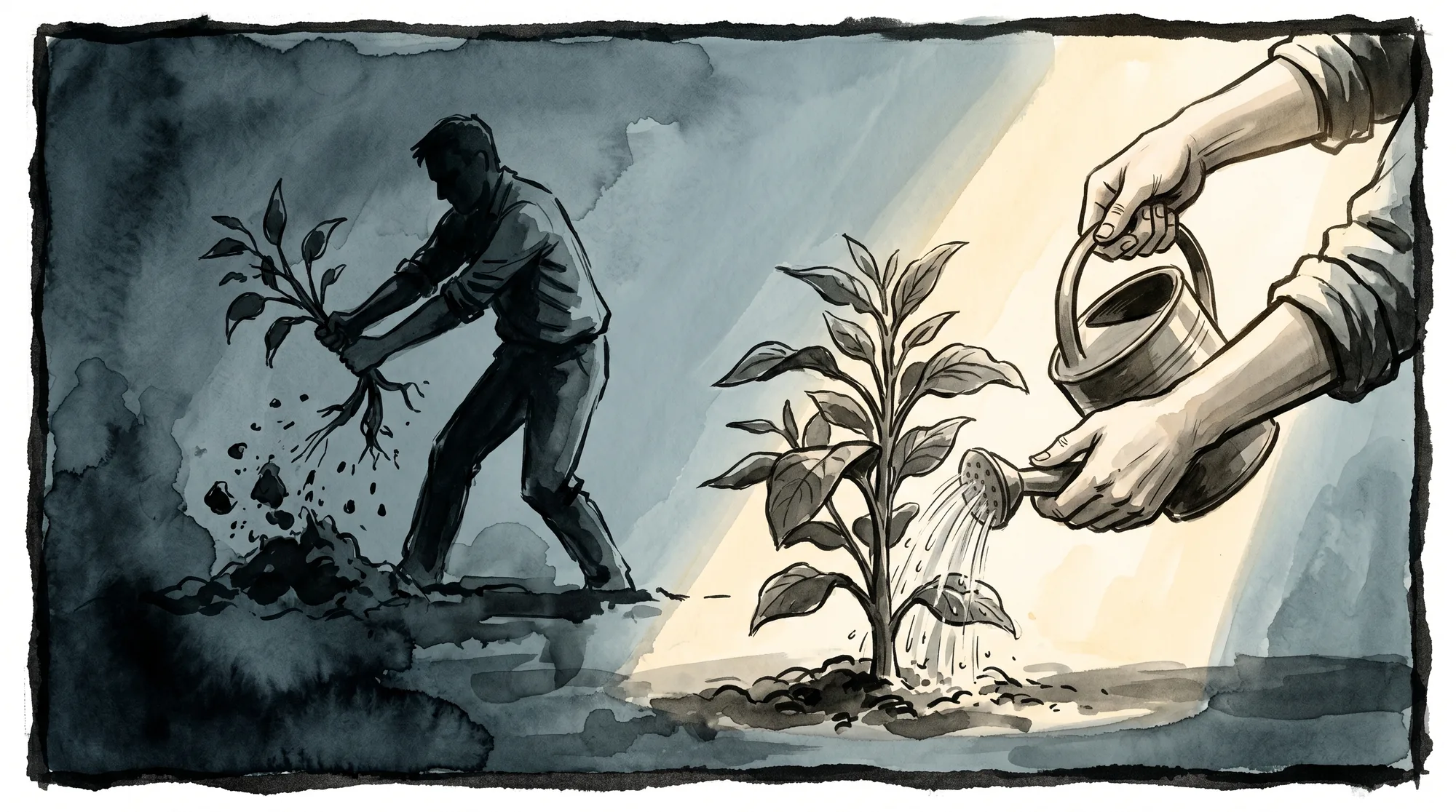
You cannot pull a plant taller. The good gardener knows the most productive thing they can do, some weeks, is leave it alone.