
Horses get the parades. Donkeys get the work.
For 5,000 years, the donkey has been the most reliable load-bearing animal on the planet, and the most underestimated. We've built civilisations on their backs and then invented an insult out of their name. "Stubborn as a donkey." "Don't be a donkey." As if refusing to walk off a cliff is a character flaw.
It isn't. It's judgement.
The "stubbornness" myth
A horse, asked to do something dangerous, will usually do it and panic afterwards. A donkey will plant its feet and assess. If the bridge looks rotten, the donkey is not moving. If the load is unbalanced, the donkey is not moving. If you haven't earned its trust, the donkey is not moving.
Ethologists have a word for this: neophobia with a strong self-preservation instinct. The rest of us call it stubbornness because it's inconvenient to us. But "the animal won't do the thing I want" and "the animal has correctly identified that the thing I want is a bad idea" are two different sentences, and we keep confusing them.
Why donkeys beat horses at hard jobs
- Load carrying. A donkey can carry up to 30% of its body weight over rough terrain all day. Horses can't sustain that.
- Water efficiency. Donkeys evolved in arid highlands. They can lose 30% of their body water and still function. A horse is in trouble at 12 to 15%.
- Feed economy. They thrive on poor forage that would make a horse thin.
- Longevity. Working donkeys routinely live into their 40s. A working horse is often done at 20.
- Guarding. A single donkey in a field of sheep will kill a fox. They don't run from threats. They engage.
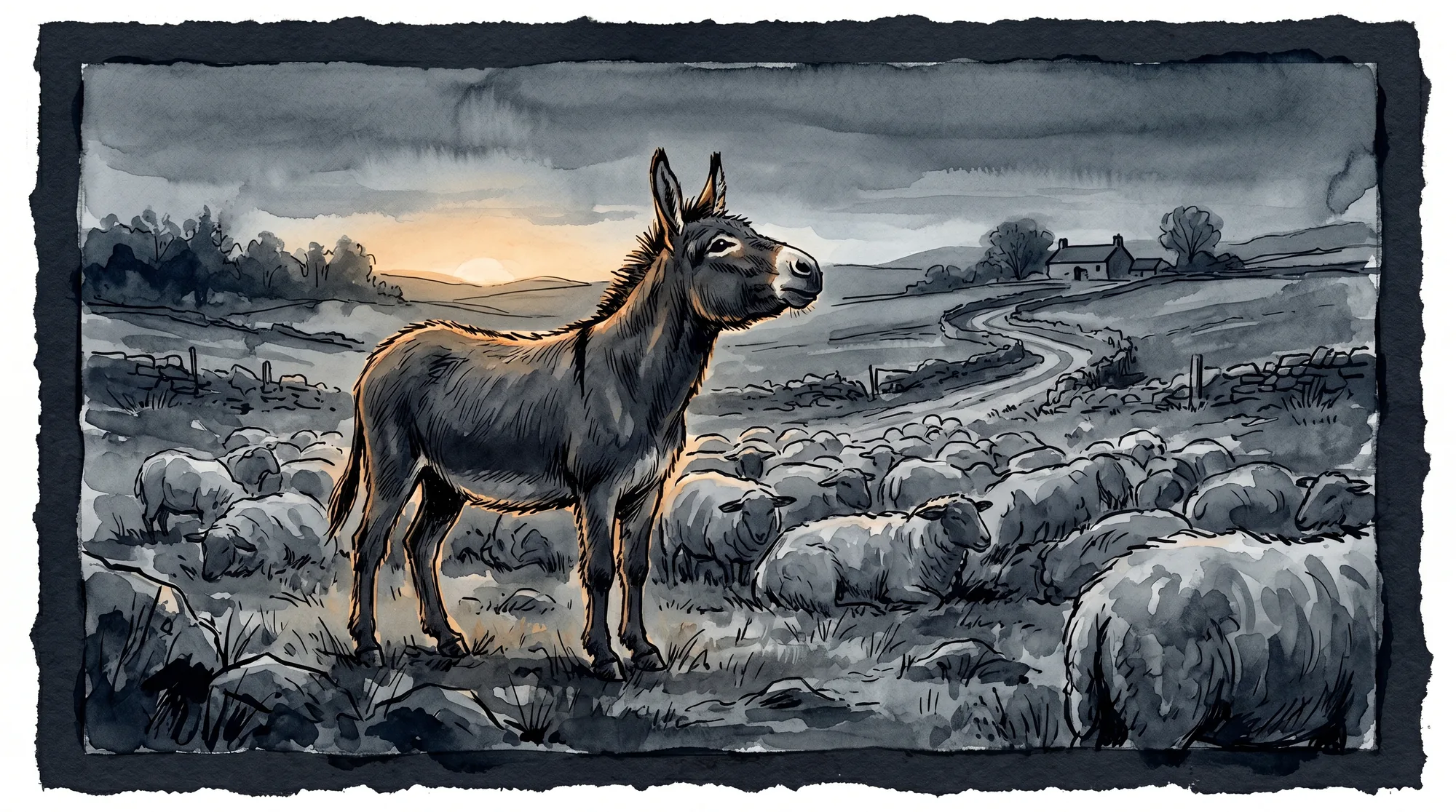
This is not a romantic animal. It's a pragmatic one.
The donkey economy
Roughly 50 million donkeys are working right now, mostly in Africa, Asia, and Latin America. They're hauling water, grain, bricks, and children to school. In large parts of the world the local economy literally moves at donkey speed. When the donkey dies, the family's income collapses.
Which is why the global trade in ejiao, a Chinese medicine made from boiled donkey hides, has been a quiet catastrophe. Demand has halved the world donkey population in some regions. The African Union voted a continent-wide moratorium on the skin trade in 2024. It wasn't sentimental. It was economic defence.
What sales leaders could learn from donkeys
I spend most of my days thinking about sales teams, so let me land this somewhere useful.
The horse sales rep is the one who charges at the quarter, takes every meeting, follows every instruction, and burns out on Friday. They're exciting to manage. They hit target until they don't.
The donkey sales rep is the one who asks, "why are we doing this?" before the call. Who refuses to push a deal that isn't ready. Who tells you the pipeline forecast is wrong. Who won't cross the rotten bridge. They're a pain in the arse to manage. They're also the ones still performing in year three.
Most sales cultures are built to reward horses and punish donkeys, which is partly a coaching problem: judgement is a behaviour you can develop, not a trait you hire for. Then we wonder why it's in short supply.
How sales cultures accidentally punish the donkey
Here's the uncomfortable bit. Almost nobody sets out to punish good judgement. It happens by accident, through the things a sales org chooses to measure and celebrate. Three patterns do most of the damage.
The first is activity worship. Count meetings booked, calls dialled, opportunities created, and you have built a scoreboard the horse wins every time. The rep who books eight low-quality meetings looks better on the dashboard than the rep who booked three real ones and walked away from a deal that was never going to close. You rewarded motion and taxed judgement, and you did it without noticing.
The second is the happy-ears forecast. When a rep says "this one's looking strong" and the manager writes it into the commit without a second question, the org has just taught everyone that optimism is free and honesty is expensive. The donkey rep who says "I think we're being used as a stalking horse here" is creating a problem for the manager's number. The horse rep who says "yeah, should close" is creating none. Guess which behaviour gets repeated.
The third is punishing the messenger. A rep tells you a deal is dead in week three. That's a gift: it's three weeks of pipeline hygiene and forecast accuracy handed to you early. But if the response is a visible flicker of disappointment, or worse, "have you really tried everything," the rep learns the lesson instantly. Next time, they'll let the deal rot quietly in stage three until the quarter ends. You didn't lose the deal because the rep gave up. You lost the honest read because you flinched.
Each of these is small. Each is rational for the manager in the moment. Compounded across a team and a year, they breed a roster of horses and quietly retire every donkey you hired.
Building a team that rewards judgement
So if you actually want donkey behaviour, refusing the bad bridge, questioning the load, telling you the forecast is wrong, you have to build for it on purpose. It will not show up on its own. A few things that work.
Measure the decision, not just the outcome. A rep who qualified out of a bad deal in week two made a good decision, even though the scoreboard records nothing. In your 1:1s, coach the call: "walk me through why you stepped away, what told you it wasn't real." Make the quality of the judgement a thing you discuss out loud, with the same seriousness you give to a closed-won. What gets coached gets repeated.
Make "I think this is wrong" a safe sentence. The single highest-leverage thing a sales leader can do is reward the rep who challenges the plan, visibly, in front of the team, even when the rep turns out to be wrong. Especially then. If challenging the forecast only feels safe when you're proven right, nobody will ever challenge it. You're not rewarding the correct answer. You're rewarding the courage to say the quiet part out loud.
Separate the dead-deal conversation from the performance conversation. A rep should be able to kill a deal without it feeling like a confession. Build a clean, blame-free ritual for it: a deal-review where "this one isn't real and here's why" is a normal, expected sentence, not an admission of failure. When killing a bad deal is administratively easy and emotionally cheap, reps do it early. When it's expensive, they hide.
Coach the judgement, deal by deal. Judgement isn't a personality test you run at interview. It's a muscle, and muscles develop under load. It develops when a rep gets asked, on a real deal, "what would have to be true for this to be a waste of your time?" and has to actually answer. That's not a question a quarterly training session can ask, because the training session doesn't know the deal. It's a question that only works in the flow of the work, on the live opportunity, every week. Which is precisely why coaching has to happen at the deal level, not the classroom level, if you want judgement to compound rather than fade. It's the same reason AI sales coaching, done properly, works the live deal rather than a quarterly curriculum.
Do this for a few quarters and something changes. The donkeys stop hiding. The horses start asking better questions. And your forecast, for the first time, starts telling you the truth.
The upgrade
Next time someone calls a teammate, or a teenager, or a customer, "stubborn as a donkey," consider the possibility that the donkey is correct.
The bridge might actually be rotten. The best thing you can do as a leader is build a team where someone is allowed to say so.
Judgement is a behaviour, and behaviours are coached, not hired. Replicate Labs gives every rep an AI coach that works the live deal with them, asking the hard qualification questions a quarterly training session never could. Start free at replicatelabs.ai, whether you're a rep, a manager, or running a whole team.