
Administration
What your coach knows
Loading your organisation's material into the coach: scopes, accepted file types, size limits, and the formats that quietly fail to index.
The knowledge base is what the coach knows about your business as opposed to about selling. Products, buyers, competitors, pricing structure, qualification standards, your methodology documents.
It is the difference between a coach that gives good generic advice and one that gives advice about your deal.
#Scope
Every document is uploaded with a scope, and the scope decides who it reaches.
#Accepted file types
| Kind | Extensions | Practical limit |
|---|---|---|
| Documents | .txt .pdf .vtt .csv .md .pptx .docx |
Around 100MB |
| Media | .mp3 .mpga .m4a .wav .mp4 .mpeg .webm |
Around 2GB |
Spreadsheets are not an accepted type. If your source is a pricing grid, a competitor comparison or a value matrix in a spreadsheet, export each sheet to Markdown or CSV first.
#Uploading
Select the file, choose the scope, and confirm the upload. Processing then runs asynchronously: the document is indexed in the background and the list shows a status when it is ready.
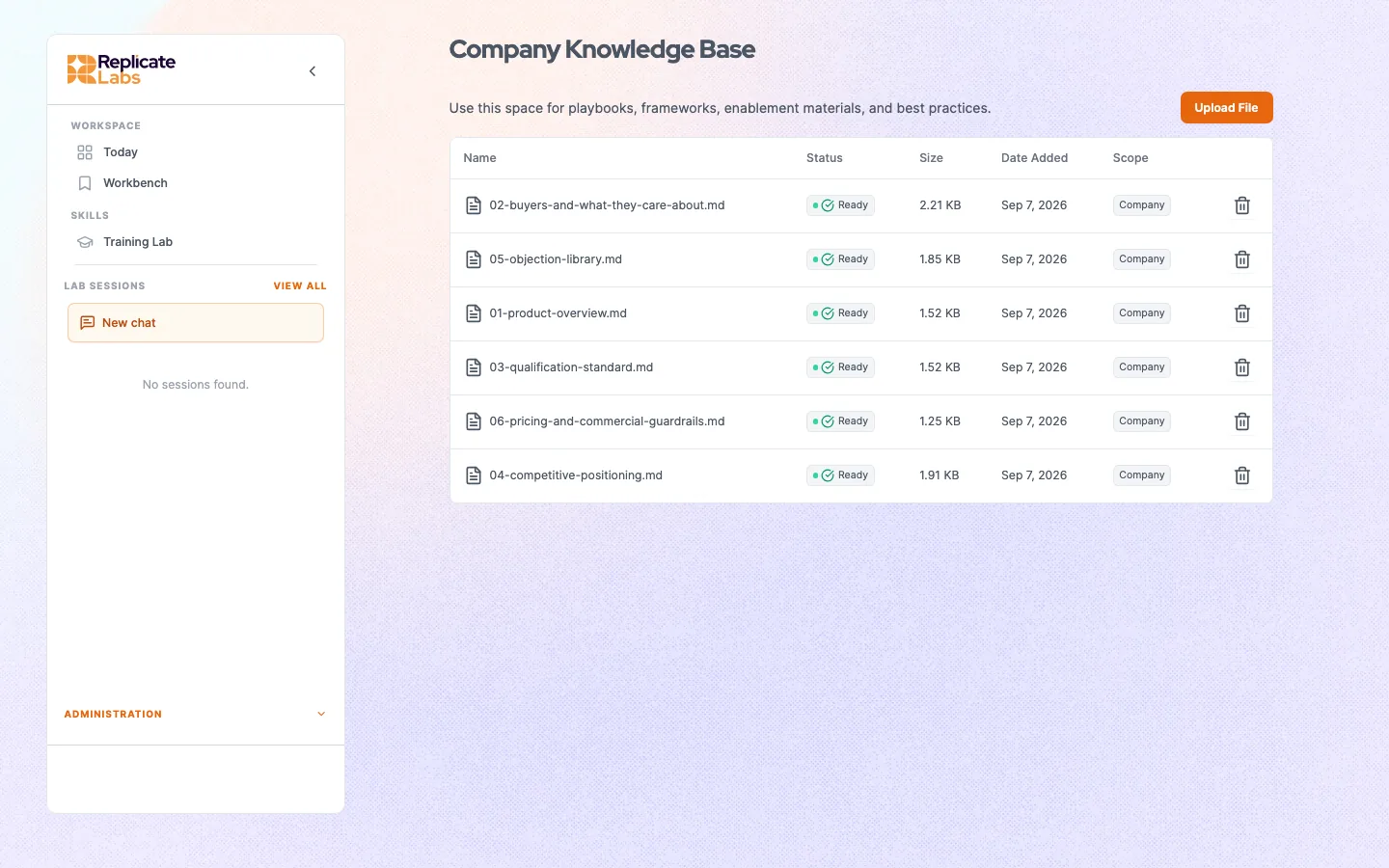
A successful upload does not mean the coach can use the document yet. Wait for the ready status before you test, or you will conclude the content is wrong when it simply has not been indexed. This is the single most common false alarm on a new account.
#Formats that fail quietly
Three cases index as empty or near-empty, with no error to tell you.
Rule of thumb: markdown and plain text beat everything. If a document matters, spend the ten minutes converting it. The retrieval quality difference is larger than any prompt change you could make instead.
#Testing that it landed
Do not test by asking the coach whether it has read a document; it will give you an accommodating answer. Test by asking a question only answerable from that document, and check the specifics.
Good: "What is our list price for the mid tier and what is the standard discount authority?" Bad: "Do you know about our pricing?"
#Replacing a document
Re-uploading does not replace an existing document. It adds a second one, and both are then retrievable.
For a straightforward superseding version this is usually harmless, because a consistent newer document simply adds detail. It is actively dangerous when the new version contradicts the old one, for example a price change: the coach can then retrieve either, and you will get inconsistent answers that are very hard to diagnose.
Delete the superseded document rather than layering over it whenever the content contradicts.
#What to load first
In this order, because the return drops steeply after the first three.
- Products. What you sell, how it is packaged, what it costs, what it does not do.
- Buyers. The titles you sell to, what each cares about, the objections they actually raise.
- Qualification standard. What your organisation requires before a deal is called qualified.
- Competitors, and how you position against each.
- Methodology material, if your coach's methodology is customised to your organisation.
Last updated 3 September 2026
View as Markdown