
For managers
The manager coach
A separate coach for people running a team: what to ask it, how it differs from the rep coach, and where it gets its answers.
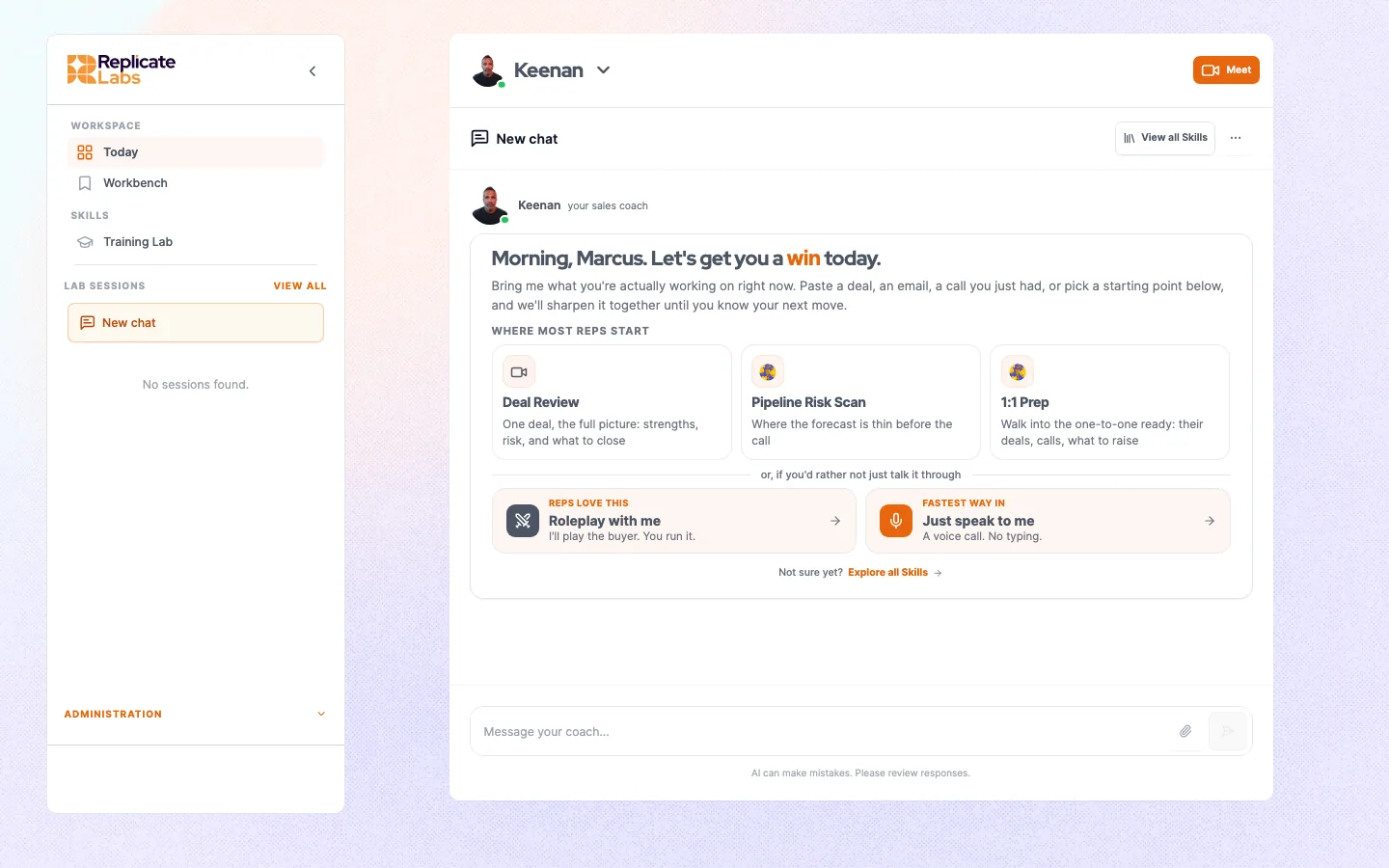
Managers get their own coach. It is a different coach, not the rep coach with a manager badge, and it reasons about a team rather than an opportunity.
If your account has one, you reach it through the coach selector, and it carries its own button row aimed at management work.
#What it is for
#Ask, do not read
You do not open a dashboard and interpret it. You ask a question and get an answer grounded in what the team has actually been doing.
Questions that work:
- "Who on my team needs an hour this week, and what should that hour be about?"
- "What is the pattern across the deals we lost last quarter?"
- "Prepare me for a conversation with a rep who keeps qualifying on the champion's word alone."
- "Which of these opportunities is thinner than the rep thinks?"
- "We have had three deals stall at the same stage. Is that a person problem or a stage problem?"
The last one is the shape of question that dashboards cannot answer and a manager coach can.
#Where its answers come from
#Preparing a one to one
The strongest single use is the fifteen minutes before a one to one. Ask what to raise, ask for the evidence, and ask how to open it so the conversation is about the capability rather than the number.
Then have the conversation yourself. See The coaching conversation.
#What it will not hand over
Ask what a rep is stuck on and you get a straight answer. Ask for the coaching conversation itself and that is not the shape of what comes back: the coach reports, it does not replay. See What you can see for where that line sits and why.
#Early accounts
A team that started last week has not generated enough signal to read patterns from, and asking for patterns anyway produces confident nonsense. Give it a few weeks of real use before you draw conclusions across a team, and treat the first month's reads as anecdotes.
Last updated 3 September 2026
View as Markdown